Competing Behavior Pathway: How to Choose Effective Function-Based Interventions
Function-based interventions are a critical component of any behavior intervention plan (BIP). Function-based interventions work by first identifying the function or purpose of the problem behavior, and then designing strategies tailored to address the specific needs of the individual. By understanding the underlying function of the behavior, practitioners can develop targeted intervention plans that maximize success and minimize potential drawbacks.
In order to choose the most effective function-based interventions, it's critical to consider environmental and cultural variables that influence the appropriateness of interventions. Failing to do this results in poor outcomes due to low treatment fidelity. Once these variables are identified, the BCBA® can then select appropriate strategies, which may range from environmental modifications to skill-building activities, to be included in a comprehensive intervention plan. The Competing Behavior Pathway is one of the best tools to help you develop an effective plan.
The Competing Behavior Pathway: The Secret to Choosing Effective Interventions for your BIP
The Importance of Choosing Function-Based Interventions
Steps to Choosing the Right Function-Based Intervention
Gathering Data from Functional Assessment
Identifying Environmental and Cultural Factors
Completing the Competing Behavior Pathway
Functionally-Equivalent Replacement Behavior
Challenges and Solutions in Choosing Function-Based Interventions
How to select the best function-based intervention for escape?
What strategies are effective for attention-based interventions?
What are the essential components of a function-based intervention plan?
What interventions are suitable for providing access to tangibles?
How to address attention-maintained problem behavior through function-based treatments?
Key Takeaways
Function-based interventions focus on the primary variables that maintain of problem behavior, leading to targeted and effective strategies.
Consideration of environmental and cultural variables is crucial for choosing and implementing an appropriate intervention plan.
Accurate identification of the functions of behavior is vital in designing tailored strategies to address individual needs effectively.
The Importance of Choosing Function-Based Interventions
Function-based interventions are crucial in addressing problem behaviors in learners. These interventions focus on identifying the function, or reinforcers, behind a learner's challenging behavior and targeting it with specific strategies tailored to address the underlying cause.
Selecting the appropriate function-based interventions for a given learner's behavior is essential to the success of the Behavior Intervention Plan (BIP) that meets the unique needs of the learner. If fail to choose a functionally-equivalent replacement behavior, the learner will choose a behavior on his own which may be more harmful than the original target behavior.
Function-based interventions:
Address the root cause of the target behavior
Are highly individualized to the learner's unique situation
Empower learners
Focus on proactive rather than reactive strategies
Traditional, one-size-fits-all approaches often focus on merely suppressing unwanted behaviors, without considering the underlying reasons why they occur. In contrast, function-based interventions focus on teaching the learner meaningful skills. By uncovering the motivation behind the behavior, BCBAs® can design interventions that not only target the problematic behavior directly but also replace it with more appropriate and functional alternatives.
Function-Based Interventions emphasize proactive measures to prevent challenging behaviors before they occur. By focusing on antecedent strategies, BCBAs® can modify the environment to minimize triggers and discourage the emergence of unwanted behaviors. This proactive approach fosters a positive and supportive environment, setting the stage for learners to develop essential self-regulation and coping skills, leading to improved behavior and overall well-being.
Function-Based Interventions offer a data-driven approach to behavior change. BCBAs® collect extensive data during functional assessments, which informs the development of behavior intervention plans. This data-driven decision-making ensures that interventions are based on empirical evidence, enhancing their reliability and efficacy.
Steps to Choosing the Right Function-Based Intervention
Gathering Data from Functional Assessment
The first step in choosing the right function-based intervention is gathering data from the functional assessment (FBA, FA, or PFA). This assessment is a comprehensive evaluation of an learner's behavior to determine the cause or what a learner gets out of a particular behavior. It is essential to accurately identify the function of the behavior, such as obtaining attention or avoiding a specific environment or situation. You will use these data to understand the learner's target behavior.
You need to understand the most common:
Setting events
Antecedents
Consequences
Make sure to consider all the different variables that maintain the learner's target behaviors. Include precursor behaviors as well as other behaviors that frequently co-occur with the most serious of the learner's target behaviors. Understanding the full context of the behavior will help you develop a highly specific plan for your unique learner.
Conducting Research
Once the data have been collected, the next step is conducting research to find evidence-based practices and interventions that match the function of the behavior. This may involve reviewing scientific articles and comparing different approaches to find the best fit for the learner or situation. Additionally, comprehensive research can provide insights into the effectiveness and potential benefits of various interventions.
Many tools are available to help you find the most relevant research. Google Scholar is a great place to start because it's publicly available and you don't need to log into an account.
In Google Scholar, when the link appears on the right side of the screen, the full article is usually available. There are helpful links below each of the articles that can help you find more relevant articles, including "Cited by" which provides a list of articles that site the article, and "Related articles."
All the articles you find will provide a list of references. This is a great source for other related articles. You will find links to many articles right within the article. This makes it easy to quickly find a large number of related articles.

The BACB provides access to ProQuest and 9 different journals that are highly important in our field. These are great tools for your research and staying up-to-date on best practices in our field.
The BACB gives all BCBAs® and BCBA-Ds® access to:
The Analysis of Verbal Behavior (full text is unavailable for the most recent year's issues)
Behavior Analysis in Practice (full text is unavailable for the most recent year's issues)
Behavior Modification
Behavioral Interventions
Journal of Applied Behavior Analysis
Journal of the Experimental Analysis of Behavior
Journal of Organizational Behavior Management
Journal of Positive Behavior Interventions
Perspectives on Behavior Science (full text is unavailable for the most recent year's issues)
These journals are great for research, but it can be hard to find articles related to specific topics. They are often a great way to browse and see what topics are coming up most often in recent research.
You want to consider the following factors when searching for research:
Diagnosis
Age
Environment
Target behavior
Resources required
This video shows how I use Google Scholar to conduct research.
Identifying Environmental and Cultural Factors
The final step in gathering the information you need to choose function-based interventions is identifying environmental and cultural factors that may be contributing to the behavior and that may impact treatment decisions. Considering these factors ensures that the chosen interventions are not only effective but also sensitive to the individual's cultural background and compatible with their environment.
For example, an intervention designed for a school setting may not be suitable for a home or community setting. Similarly, accounting for cultural factors could mean adapting communication styles or incorporating culturally relevant materials into the intervention. If you fail to consider these factors, your behavior plan will likely not be successful.
Completing the Competing Behavior Pathway
The Competing Behavior Pathway is a crucial step in selecting function-based interventions for addressing problem behavior. It enables BCBAs® to systematically analyze the different variables that maintain target behavior and develop an effective plan to address these variables.
Use the competing behavior pathway to choose interventions to address the most common:
Setting events
Antecedents
Target behavior(s)
Consequences
Going through this process step-by-step helps to develop a comprehensive behavior intervention plan (BIP) that meets the needs of your individual learner. The Competing Behavior Pathway pictured below provides a visual to make the process easier.
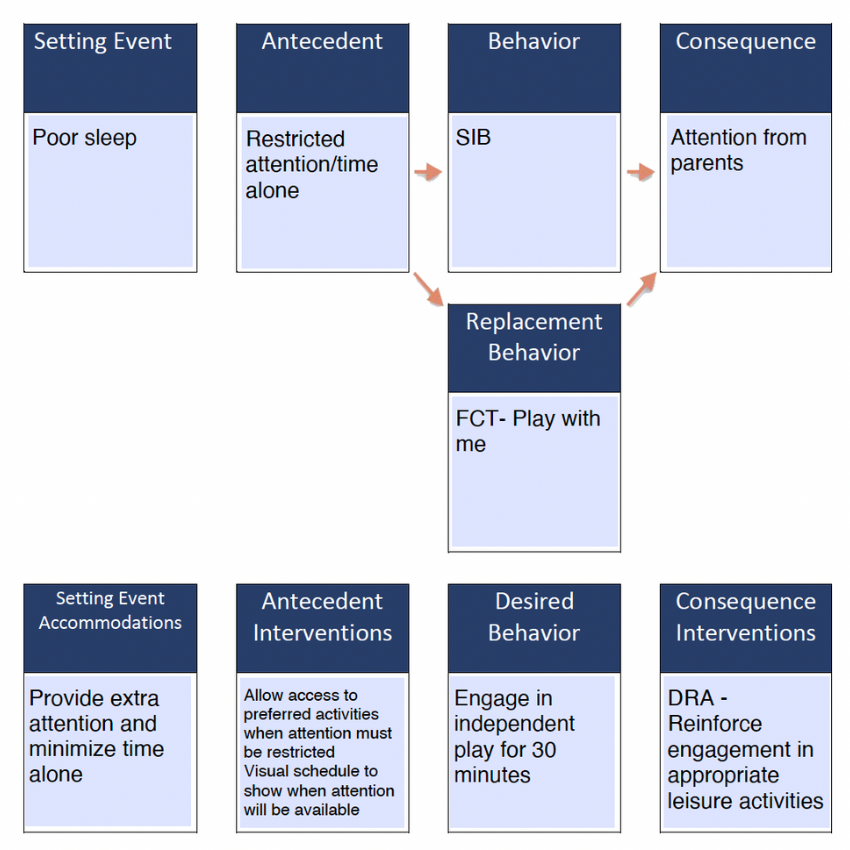
To complete the Competing Behavior Pathway, begin in the top left and work your way to the bottom right. The top row includes the most common:
Setting events
Antecedents
Behaviors that are part of the context
Consequences
Next, comes the work of planning the route to the desired outcomes. To do this, you will complete the remaining pieces of the Competing Behavior Pathway:
Functionally-equivalent replacement behavior
Setting event accommodations
Antecedent interventions
Desired behavior
Consequence Interventions
The video below walks you through the examples here.
Functionally-Equivalent Replacement Behavior
The functionally-equivalent replacement behavior is a behavior that the learner engages in when the antecedents come up that results in the same consequences as the target behavior(s) . This is often not your terminal goal, but is a behavior that is preferable to the target behavior. Take a look at the example below. The top row is data that comes from the FBA.
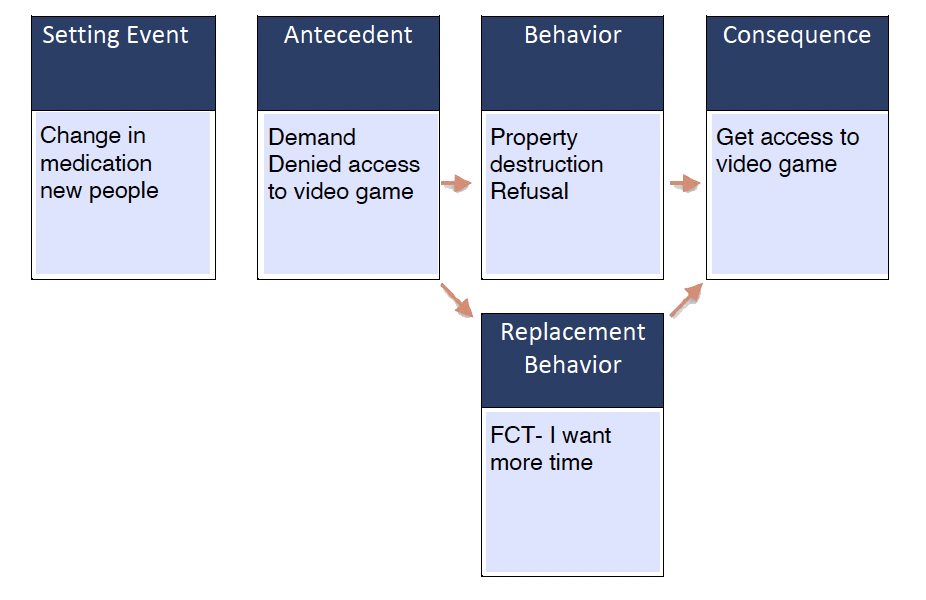
In this example, the learner engages in property destruction and refusal when there's a demand and he's denied access to his video games. The maintaining consequence is that he often gets access to the video game.
Choose a replacement behavior that results in the same consequence as the target behavior. Here, that would be him asking for more time with his video game. Ultimately, his mother might need him to transition away from the video game more quickly but asking for more time is far preferable to property destruction since he has broken several windows.
Let's look at one more example.
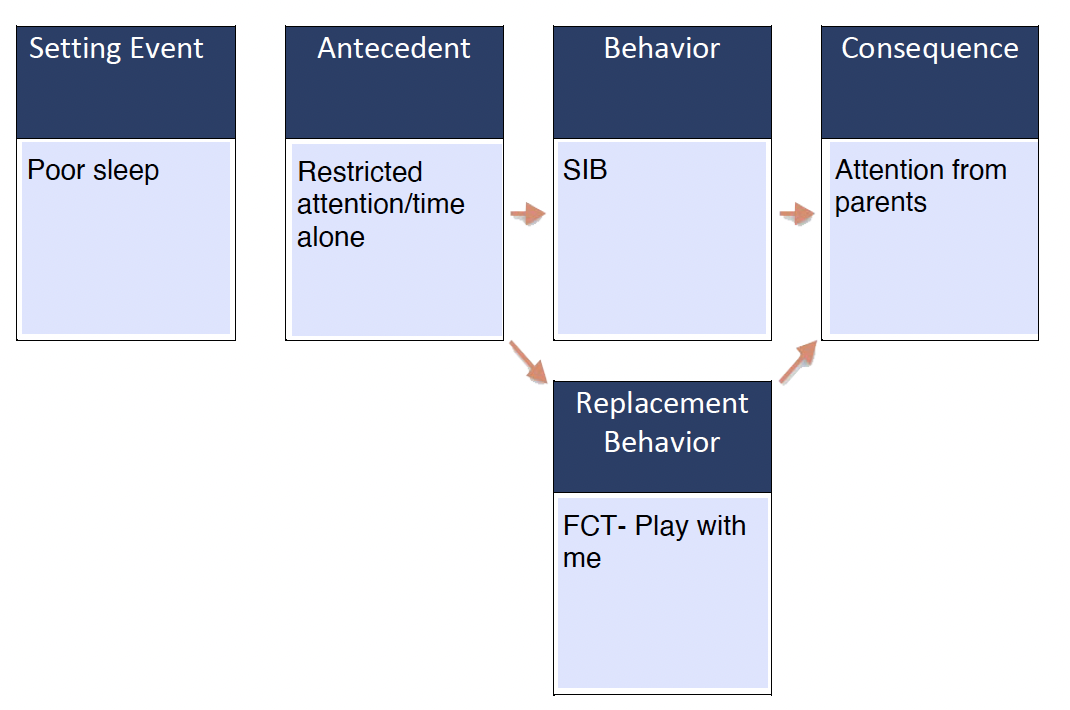
In this example, the learner engages in SIB when attention is restricted or when he spends time alone. The maintaining consequence is attention from his parents. Choose a functionally-equivalent replacement behavior that results in the learner receiving the same consequence. In this example, you might teach the learner to ask for his parent's attention by saying "play with me. " If the learner doesn't speak, you might teach him an alternative way to communicate this phrase (i.e. picture exchange or communication device).
Setting Event Accommodations
Next consider the most common setting events and determine how you will adjust the environment, expectations and/or interactions to reduce the impact of these setting events on the learner's behavior. Let's take a look at our examples again.
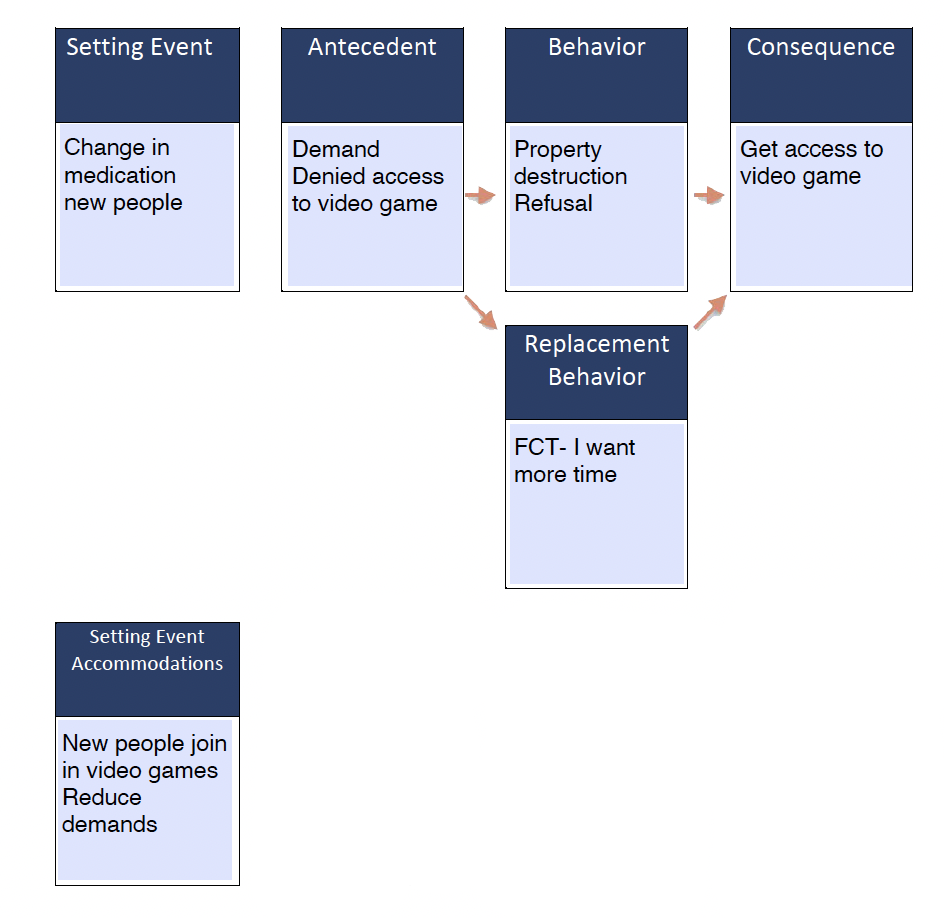
In this example, consider the most common setting events:
Change in medication
New people
What changes can be made to the environment, expectations and/or interactions when these setting events are present?
New people can join him in his video games
Reduce demands
There are a number of additional options you might choose as well such as:
Allowing extra time for video games
Identifying a quiet place the learner can go to be away from new people
Let's take a look at our second example.
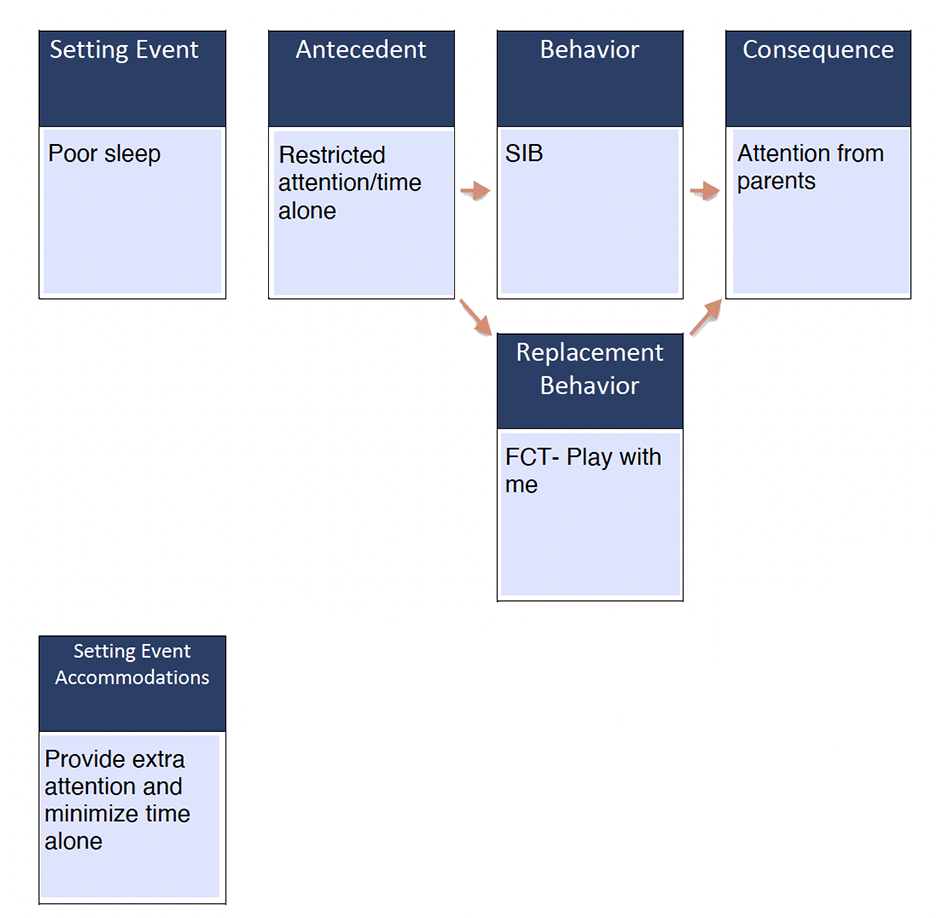
Here is our access to attention example. For this learner, the most common setting event is poor sleep.
What changes can be made to the environment, expectations and/or interactions when this setting event is present?
When the learner has poor sleep, you could:
Provide extra attention noncontingently
Minimize the time the learner spends alone
As with the other example, there are many different ways you might choose to lesson the impact of the setting events. Consider what is most relevant to the specific learner and the context within which the challenging behavior occurs.
Antecedent Interventions
Antecedent interventions play a significant role in preventing problem behavior. These interventions focus on altering the environment or conditions preceding the behavior. They help to minimize the impact of the triggers that lead to the target behavior and promote appropriate choices.
Let's continue with our previous examples.
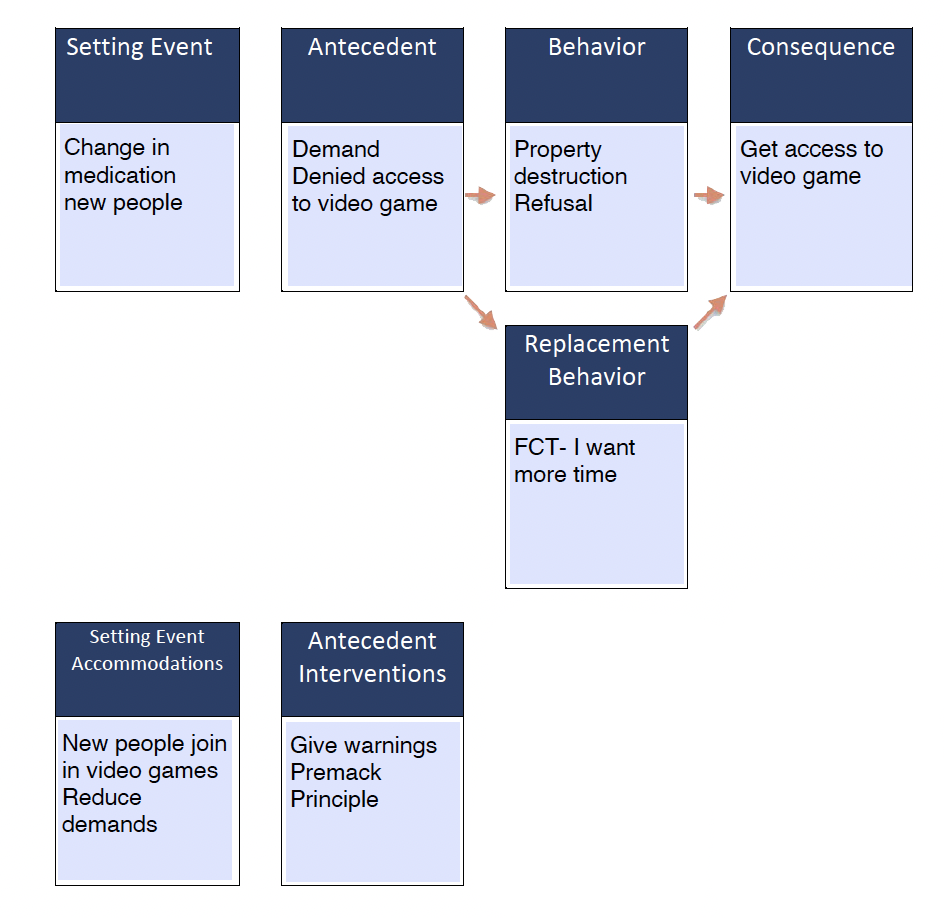
In this example, the most common antecedents are:
Demands
Denied access to video games
What antecedent interventions might reduce the impact of these antecedents on the learner's target behavior?
Give warnings of upcoming demands or transitions
Use the Premack Principle to let the learner know he can have the video game back following the task
Let's look at antecedent interventions for the second example.
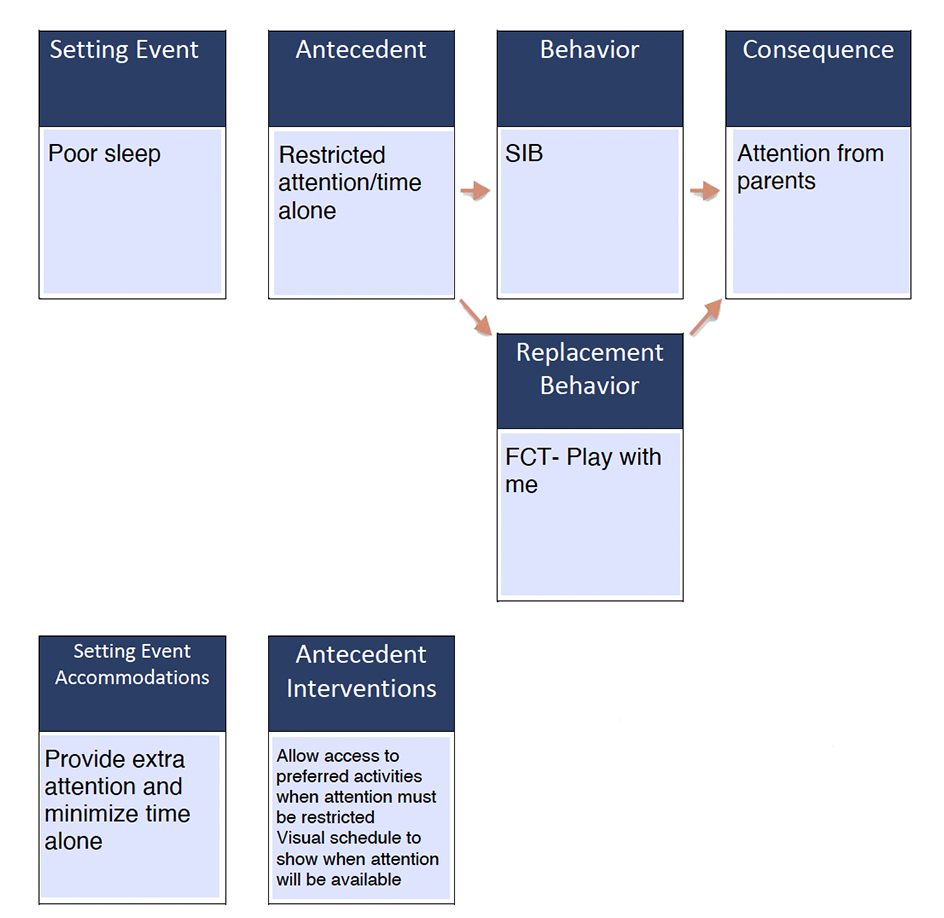
In this example, the most common antecedents are:
Restricted attention
Time alone
What antecedent interventions can be used to minimize the impact of the common antecedents on the learner's tareget behavior?
Allow access to preferred activities when attention must be restricted
Use. a visual schedule to show when attention will be available
These are examples only. There are many different antecedent interventions available and the right one for your learner will depend on the learner's specific needs.
Desired Behavior
Here is where you determine the ultimate desired behavior. You chose the functionally-equivalent replacement behavior, but that behavior usually comes at the expense of some important skills or opportunities. Consider the context within which the target behavior(s) commonly occur. How should the learner ideally respond?
Let's continue with our examples.
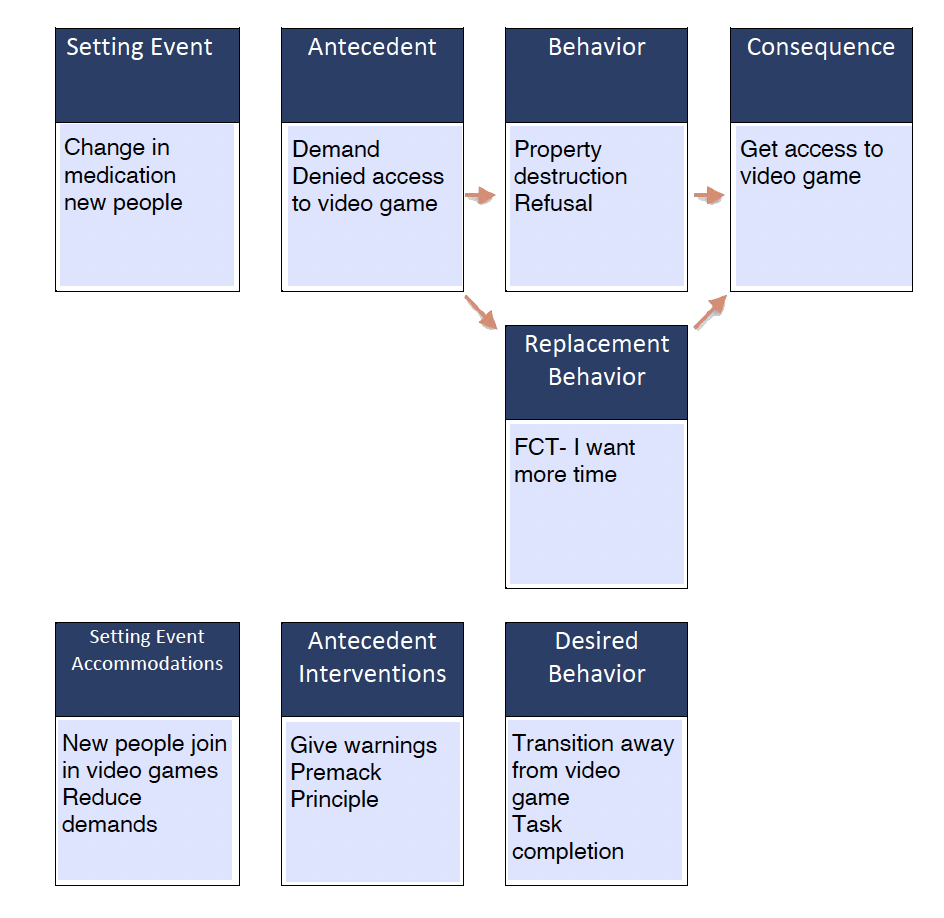
In this example, you determined that the learner could ask for more time with his video game. What do you ultimately want the learner to be able to do when demands and denied access come up?
Transition away from the video game
Complete tasks
Let's do the same for the second example.
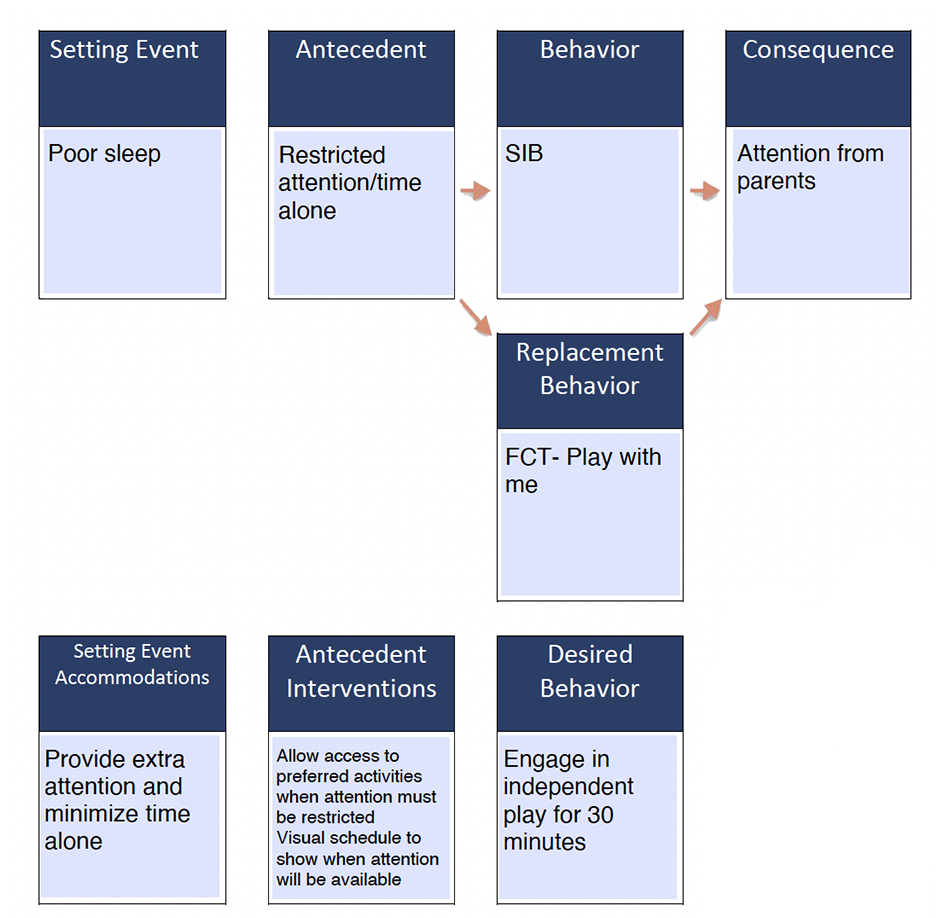
In this example, the functionally-equivalent replacement behavior was to teach the learner to ask for attention by asking his parents to play with him. What do you ultimately want the learner to be able to do when attention is restricted or he needs to spend some time alone?
Engage in independent play for 30 minutes
The learner's parents likely need him to engage in activities on his own for periods of time so they can cook dinner, complete chores, or even shower. This looks like a reasonable and meaningful goal.
Consequence Interventions
When completing the final piece to the Competing Behavior Pathway, choose consequence interventions that will reinforce the desired behavior you selected. These are most commonly some form of Differential Reinforcement procedure but might also include interventions such as token economy or even group contingencies.
Let's finish out our 2 examples.
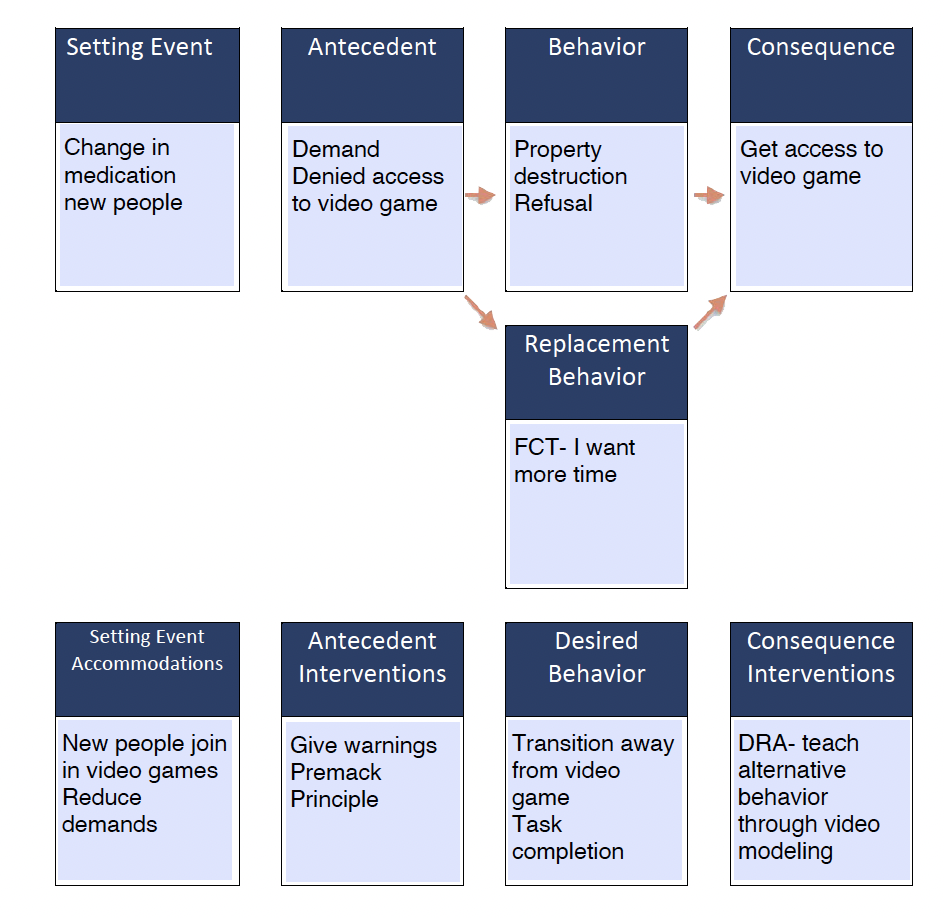
In this example, you want the learner to transition away from video games and complete tasks. You might choose to include the following consequence interventions in your BIP:
Differential Reinforcement of Alternative Behavior (DRA): reinforce appropriate transitions and task completion
Teach skills and alternative behavior through video modeling since the learner enjoys watching videos
Let's finish the final example.
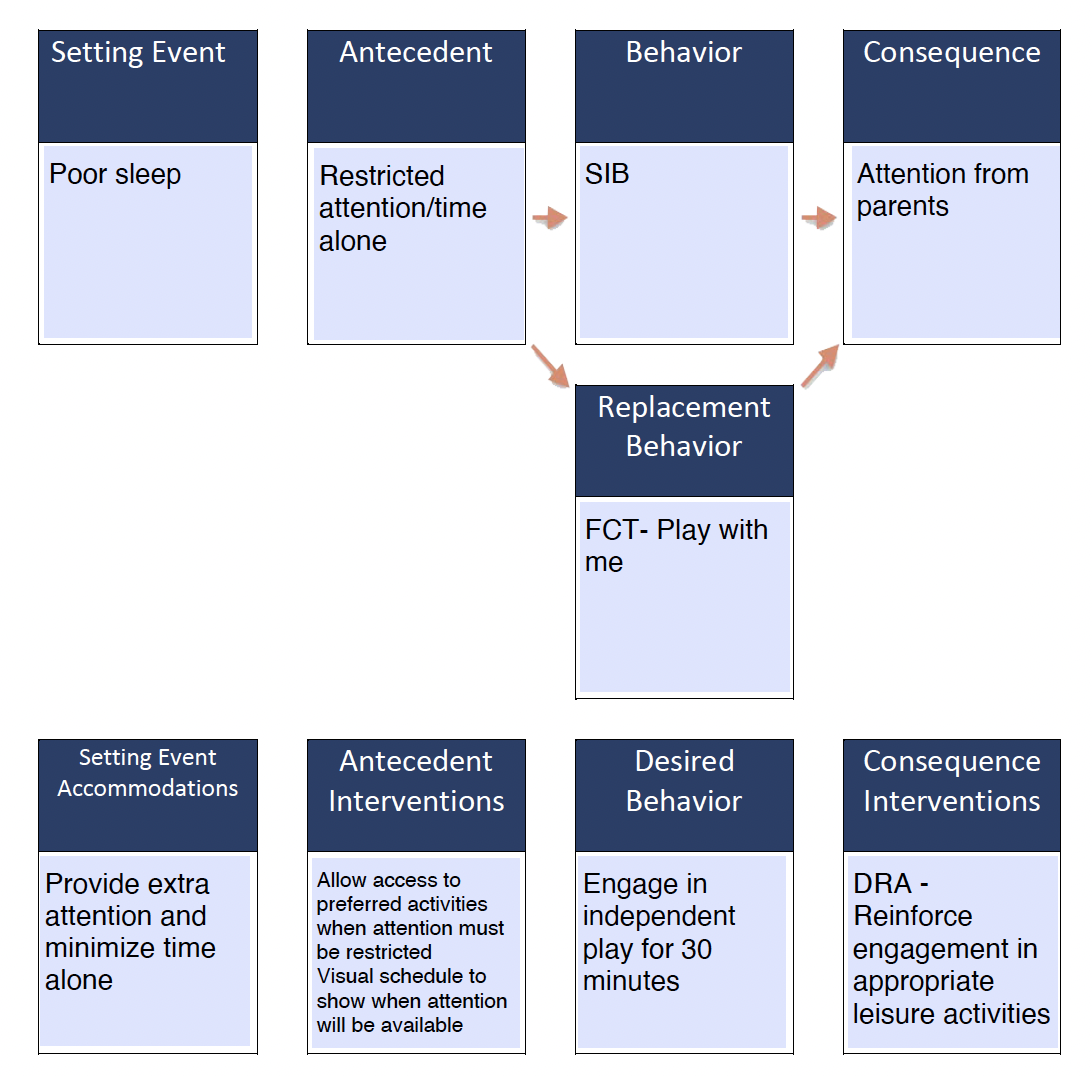
In this example, you want to choose a consequence intervention that will reinforce the learner's engagement in independent play. You might choose:
Differential Reinforcement of Alternative Behavior (DRA): reinforce engagement in appropriate leisure activities
When writing your behavior intervention plan (BIP), you will want to go into more detail about which behaviors will be reinforced and the schedule of reinforcement.
It is essential to build a comprehensive behavior intervention plan that considers setting event accommodations, antecedent interventions, skill development, and consequence interventions to effectively address problem behavior. Careful consideration and application of these strategies will contribute to successful outcomes in function-based interventions.
Challenges and Solutions in Choosing Function-Based Interventions
Common Challenges
Choosing the appropriate function-based interventions for addressing challenging behavior can be a complex task. One of the main challenges is the difficulty in accurately identifying the underlying function of the behavior. Without a clear understanding of the function, it becomes challenging to select the most effective intervention strategies.
Another challenge is related to access and implementation of intervention resources. Some schools, clinics and home environments might have limited available resources to effectively implement interventions that might otherwise be effective. These barriers may make it difficult for professionals and educators to access and implement proper intervention strategies.
Lastly, the creation of a comprehensive function-based support plan requires collaboration among different professionals, educators, and family members. Coordinating these stakeholders and aligning their efforts can be challenging and time-consuming.
Potential Solutions
To overcome these challenges, several solutions can be applied. First, it is crucial to conduct a thorough functional assessment to identify the root causes of the problematic behavior. This assessment should involve observation, data collection, and analysis to determine the driving factors behind the behavior. Once the function is understood, evidence-based function-based interventions can be selected more easily, and the chances of intervention success are increased.
When dealing with resource limitations, exploring alternative means of obtaining intervention resources or training can be helpful. For example, schools or clinics can provide training workshops for educators and professionals to ensure they have the knowledge and skills to implement interventions effectively. Schools or clinics may also consider revising their resource policies to include the resources necessary to implement function-based interventions that address challenging behaviors, prioritizing resources that have proven effectiveness.
When developing a function-based behavior support plan, clear communication and collaboration among all stakeholders are essential. Regular meetings and status updates can help synchronize efforts and ensure that everyone involved in the intervention process understands their roles and responsibilities. Additionally, utilizing collaborative tools like shared documents or platforms can aid in streamlining the plan's development and implementation.
By addressing these challenges and employing appropriate solutions, educational institutions and professionals can successfully select and implement function-based interventions to support learners with challenging behaviors.
Frequently Asked Questions
How to select the best function-based intervention for escape?
When choosing a function-based intervention for escape-maintained problem behavior, it's essential to consider the individual needs of the learner. A clinical model helps in determining the appropriate intervention by examining the student's preferred activities and evaluating situations where escape-maintained behaviors could occur. Implementing activity choice interventions (shared control) may minimize the instances of these problem behaviors.
What strategies are effective for attention-based interventions?
Effective attention-based interventions often involve teaching and reinforcing appropriate behaviors that serve a similar function to problem behaviors. Strategies may include differential reinforcement, social skills training, and providing non-contingent attention. By redirecting the student's action using function-based treatments, educators can promote adaptive responses and reduce the frequency of the problem behavior.
What are the essential components of a function-based intervention plan?
The critical components of a function-based intervention plan include a clear definition of the problem behavior, the identification of its function, the selection of evidence-based strategies for setting events, antecedents, skill development and consequences as well as a data collection plan to evaluate the effectiveness of chosen interventions. By implementing suitable function-based interventions, professionals can support learners in developing appropriate alternative behaviors that serve the same function as problem behaviors.
What interventions are suitable for providing access to tangibles?
Interventions focused on providing access to tangibles can involve the use of token economies, reinforcement schedules, functional communication training, and delay tolerance training. These strategies help students learn to access tangibles in an appropriate manner without engaging in problematic behaviors.
How to address attention-maintained problem behavior through function-based treatments?
Function-based treatments that target attention-maintained problem behavior involve teaching adaptive skills that help learners receive attention more appropriately. By reinforcing alternative behaviors and utilizing strategies such as functional communication training, the learner learns to replace problem behaviors with more socially acceptable actions. Professionals can, therefore, manage attention-maintained problem behaviors effectively by implementing well-suited function-based treatments.
References and Related Reading
Blood, E., & Neel, R.S. (2007). From FBA to implementation: A look at what is actually being delivered. Education and Treatment of Children, 30 (4), 67–80. doi: 10.1353/etc.2007.0021
Cox, L. V. (2016). Training Early Childhood Educators to Identify Behavior Function and Select Function-Matched Interventions.
Crone, D. A., & Horner, R. H. (2003). Building positive behavior support systems in schools: Functional behavioral assessment. New York: Guilford.
Horner, R. H. (1994). Functional assessment: Contributions and future directions. Journal of Applied Behavior Analysis, 27(2), 401–404. doi: 10.1901/jaba.1994.27-401
Horner, R. H., Sugai, G., Todd, A. W., & Lewis-Palmer, T. (2000). Elements of behavior support plans: A technical brief. Exceptionality, 8(3), 205-215.
Huntington, R. N. (2018). Examining the Effectiveness of Student Involvement in the Functional Behavior Assessment and Intervention Process (Doctoral dissertation).
Kim, J. (2012). Effects of functional communication training (fact) on the communicative, self-initiated toileting behavior for students with developmental disabilities in a school setting.
Ingram, K., Lewis-Palmer, T., & Sugai, G. (2005). Function-based intervention planning comparing the effectiveness of FBA function-based and non-function-based intervention plans. Journal of Positive Behavior Interventions, 7(4), 224–236. doi: 10.1177/10983007050070040401
Gresham, F. M., & Noell, G. H. (1998). Functional analysis assessment as a cornerstone for noncategorical special education. Functional and noncategorical identification and intervention in special education, 39-64.
Kern, L., Gallagher, P., Starosta, K., Hickman, W., & George, M. L. (2006). Longitudinal outcomes of functional behavioral assessment-based intervention. Journal of Positive Behavior Interventions, 8, 67–78. doi: 10.1177/10983007060080020501
McIntyre, L. L., & Golya, N. (2016). Assessment of Behavior Problems and the Use of Functional Behavioral Assessment During Early Childhood. Early Childhood Assessment in School and Clinical Child Psychology, 119-138.
Pinkelman, S. E. (2014). Effects of self-delivered performance feedback and impact assessment via the individual student information system (ISIS-SWIS) on behavior support plan treatment fidelity and student outcomes (Doctoral dissertation, University of Oregon).
Robinson, J., Duncan, K., London, D., Gershwin, T., Trapp, L., & Shen, G. (2022). Prevention Is the Best Intervention: Proactive Strategies for Supporting Students Who Engage in Escalated Behaviors. Beyond Behavior, 31(3), 163-174.
Sennott, S., Loman, S., Park, K. L., Pérez, L. F., Kennedy, M. J., Romig, J., & Rodgers, W. J. (2015). Comprehensive individualized curriculum and instructional design, 61-87.
Skinner, C. H. (2001). Functional Behavioral Assessment: Principles, Procedures. School Psychology Review, 30(2), 156-172.
Strickland-Cohen, M. K. (2012). An examination of the efficacy of training school personnel to build behavioral interventions from functional behavioral assessment information (Doctoral dissertation, University of Oregon).
Tobin, T. J., Lewis-Palmer, T., & Sugai, G. (2002). School-wide and individualized effective behavior support: An explanation and an example. The Behavior Analyst Today, 3(1), 51.


