
Functional Communication Training (FCT): The Most Important Intervention In Your ABA Toolbox
Functional Communication Training (FCT): The Most Important Intervention in Your ABA Toolbox
Few interventions in ABA are as transformative—or as universally applicable—as Functional Communication Training (FCT). When a learner doesn’t yet possess the communication skills needed to get their needs met, behavior becomes their language. FCT gives them a more effective, socially valid, and sustainable way to communicate.
Every BCBA®, RBT®, teacher, and parent supporting autistic learners or individuals with communication delays should have FCT at the center of their intervention toolkit. When implemented well, it reduces challenging behavior reliably and efficiently while building a foundation for long-term skill development.
Key Takeaways
FCT replaces challenging behavior with a functional, efficient communicative response.
Successful FCT always begins with identifying the correct function of behavior.
Any communication modality can be used—speech, signs, AAC, PECS, or simple gestures.
Generalization and reinforcement thinning must be intentionally structured.
FCT is simple to understand but must be implemented with precision to avoid behavior chains.
What Is Functional Communication Training (FCT)?
Functional Communication Training is an evidence-based ABA intervention in which you teach a learner a functionally equivalent communicative response that meets the same need the challenging behavior previously served.
Put simply:
You teach the learner a new behavior that works better than the challenging behavior.
Challenging behavior is communication—and often the most efficient communication the learner has. Individuals rely on it because:
They don’t have the communication skills they need, or
Their attempts at communication have not worked reliably in the past.
FCT flips this dynamic by teaching a new communicative response that is:
Easy for the learner to use
Consistently reinforced
Contextually appropriate
Directly tied to the true function of behavior
When those conditions are met, FCT becomes one of the fastest, most humane, and most durable ways to reduce challenging behavior.
Why Use Functional Communication Training (FCT)?
Functional Communication Training is a cornerstone ABA intervention that teaches learners to replace challenging behavior with a functionally equivalent communicative response. In simple terms:
FCT shows the learner a more effective, socially valid way to get their needs met.
When communication breaks down, behavior steps in. Many autistic learners—and others with language delays—rely on behavior because it works. FCT flips that script by teaching a communicative response that provides the same reinforcer that previously maintained the challenging behavior.
Two key realities drive almost every case where FCT is needed:
The learner cannot communicate well enough to meet their own needs independently
The learner can communicate, but their efforts aren’t effective or honored
FCT solves both problems by redefining communication as a powerful, reliable tool. Once a learner sees that communication works better than challenging behavior, everything shifts. You’ll often see:
Decreases in aggression, tantrums, and elopement
Increases in independence and self-advocacy
Improved relationships across home, school, and community
Teach the Communicative Response
Once you’ve identified the function of behavior and selected an appropriate communicative response, the real work begins: teaching the learner to use that response fluently, confidently, and before challenging behavior occurs.
This is the phase where FCT becomes transformative—when communication starts replacing dysregulation, and learners finally gain access to what they need without relying on behaviors that put their safety, relationships, and learning at risk.
Create Instructional Opportunities With Intention
High-quality FCT instruction doesn’t rely on waiting for a problem behavior to happen. Instead, you engineer situations where the EO (or MO) is present but controlled, and you prompt the communicative response before behavior escalates.
You’re working proactively, not reactively.
This is where many teams fall apart—not because they don’t understand FCT, but because they forget this foundational rule:
If you teach the communicative response after the challenging behavior occurs, you’re reinforcing the chain.
That’s how we accidentally strengthen the very behavior we’re trying to replace.
Use Precursor Behaviors as Your Cue
Every learner has signals—subtle, early indicators that escalation is starting. These precursor behaviors are your window of opportunity.
Examples include:
A glance toward a preferred item
Slowing down when a demand is presented
A sigh or brief vocal protest
Turning away or tensing shoulders
As soon as these precursors appear, you prompt the communicative response immediately.
This timing is what prevents the learner from practicing the target behavior and teaches them a more efficient way to access reinforcement.
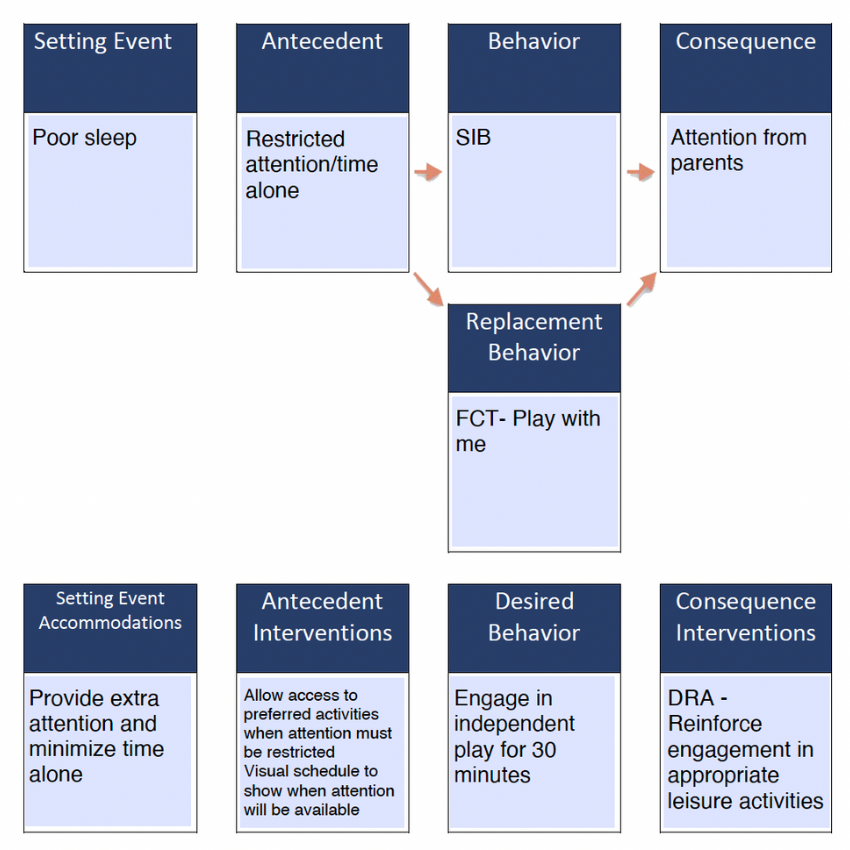
The Competing Behavior Pathway (pictured below) is the best tool to help you identify the phrase you should teach. It is a visual representation of the context in which the challenging behavior occurs with space for you to consider interventions for each component of the context.
A Real-Life Example (And Why Prompt Timing Matters)
Meet Josie, a 3-year-old autistic learner whose challenging behavior escalated significantly when staff attempted to teach her to request the iPad.
Staff prompted her to say, “I want iPad” after she began to tantrum.
What happened?
Tantrums skyrocketed.
Manding increased to excessive levels.
The iPad became a default escape from any demand.
Josie spent most of her session either crying or using the device.
This wasn’t “bad behavior.”
It was perfect learning—just not the learning we wanted.
Why?
Because the chain became:
Tantrum → prompted mand → access to iPad
To fix this, staff learned to:
Identify triggers (seeing another child with an iPad)
Prompt the mand before the tantrum
Reinforce calm, early communication
Avoid reinforcing communication that followed problem behavior
For learners whose wants change rapidly, an omnibus mand (“my way,” “something else,” etc.) may be the most functional option—especially for early FCT rooted in PFA/SBT.
What Teaching Looks Like in Practice
Engineer the EO
Set up a context where the learner is likely to want the reinforcer.Prompt the communicative response early
Use the least intrusive prompt that guarantees success.Deliver reinforcement immediately
Reinforcement must perfectly match the function you identified in Step 1.Repeat trials across varied contexts
You’re building fluency and strengthening the response under multiple conditions.Avoid reinforcing any communication following the problem behavior
Prevent behavior chains and ensure the replacement truly becomes more efficient.
Create Opportunities to Practice the Communicative Response Across Different Contexts
Once the learner reliably uses the communicative response during teaching sessions, it’s time to extend that skill across the environments where challenging behavior typically occurs. Generalization is not optional in FCT—it’s the entire point. A replacement response that only works in one setting is not a replacement at all.
Here’s how to make this step effective and sustainable:
Rehearse the Communicative Response Across Real Contexts
Create structured opportunities for the learner to practice the new communication in situations that naturally evoke the target behavior. This may include:
Transitions
Task demands
Peer interactions
Waiting situations
Denials or delays
In each context, your job is to prompt early and deliver reinforcement consistently, so the learner contacts success across multiple scenarios.
Use Precursor Behaviors to Guide Timing
Just like in teaching, prompt the communicative response at the first sign of precursor behaviors—not after escalation has already begun.
This prevents the development of a behavior chain in which:
Challenging Behavior → Prompt to Communicate → Reinforcement
If this chain forms, the challenging behavior becomes part of the mand—exactly what you want to avoid.
Generalization Requires Systematic Prompting and Fading
As the learner becomes more fluent:
Fade prompts slowly and intentionally.
Ensure independence in each setting before moving to the next.
Reinforce consistently so the communicative response remains more efficient than the target behavior.
Generalization fails when fading happens too quickly or reinforcement becomes inconsistent.
The Role of Caregiver and Teacher Training
If generalization is inconsistent across adults, reinforcement is inconsistent across adults—and that means challenging behavior will remain in the learner’s repertoire.
Provide stakeholders with:
Clear instructions
Modeling
Decision-making rules (e.g., when to reinforce, when to prompt, when to wait)
This step is essential, especially when the behavior is dangerous or highly disruptive.
Generalization Example
In the Peter example from earlier:
He learned to request a break at school.
His behavior decreased dramatically in the classroom.
But at home? His aggression increased.
Why?
Because he learned a replacement behavior tied to school, while home continued to reinforce aggression.
When one setting strengthens the appropriate response but the other continues reinforcing the problem response, you get behavioral contrast.
The solution:
Train caregivers and ensure the new communication response is reinforced everywhere the original behavior was successful.
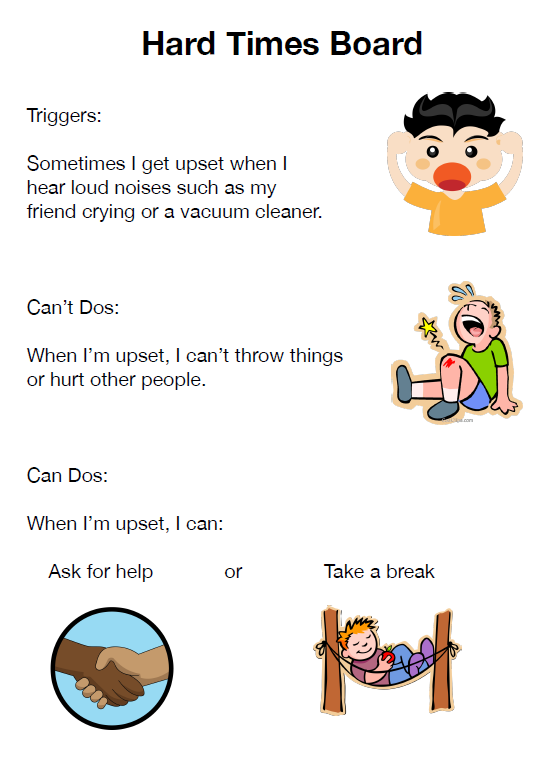
In the post: Autism and Social Skills: A Complete Guide we discuss the use of a Hard Times Board to teach functional communication as a replacement for challenging behavior. In the example below, the social story includes a functional way for the child to use language to escape from an aversive stimuli (a loud noise). The social story identifies the triggers, things the child can't do and then what the child can say to get away from the noise.
Thin the Schedule of Reinforcement
Thinning reinforcement is the phase where FCT either becomes sustainable in real life—or collapses under the weight of impractical reinforcement demands. This step requires finesse. Your goal is straightforward: maintain the effectiveness of the communicative response while gradually shifting toward more natural reinforcement schedules.
When thinning is done well, learners continue to use communication because it remains easier and more reliable than engaging in the target behavior. When thinning is rushed or poorly planned, problem behavior resurges and teams mistakenly conclude that “FCT isn’t working.”
Here’s how to thin reinforcement the right way.
Introduce Delayed Reinforcement
Start with tiny delays. We’re talking seconds, not minutes.
Provide reinforcement immediately when the learner first acquires the new communicative response.
Once responding is consistent, insert a gentle delay:
– “Sure, you can have a break—in a moment.”
– “Yes, iPad—just a second.”
These micro-delays build the learner’s tolerance without signaling that the communicative response is less valuable.
Why delays matter: They mimic the real world. No one gets what they want instantly, and emotional regulation during waiting is a skill worth shaping.
Decrease the Magnitude of Reinforcement Gradually
Magnitude fading is often overlooked but essential.
If a learner originally receives 5 minutes of escape or access to the tangible:
Fade to 4 minutes 30 seconds
Then 4 minutes
Only reduce in small steps—too much too soon triggers problem behavior
Learners shouldn't feel the contingency eroding beneath them. The shift must be subtle.
Shift to Intermittent Reinforcement
Once delays and magnitude fading are stable, begin reinforcing the communicative response on a variable schedule (VR). This decreases predictability in access, which more closely resembles natural environments.
Move from FR1 → VR2
Then VR2 → VR3
Continue only when data show stable responding
Variable schedules are powerful. They reduce resurgence, promote maintenance, and support increasingly natural communication patterns.
Monitor Closely and Adjust Fast
Thinning is never linear. You will see signs when you’ve moved too fast:
Increased precursor behaviors
Slower manding
Emotional dysregulation
Spikes in problem behavior
When this happens, return to the last successful step, stabilize, and proceed more slowly.
A data-driven approach is non-negotiable.
The Reinforcement Must Always Be Easier to Obtain Through Communication
This principle cannot be overstated.
Here’s the classic pitfall:
You teach a 6-year-old, Peter, to mand for a break. At FR1 he thrives—problem behavior plummets.
But when you thin to:
“You can have a break after 1 minute of work.”
Peter realizes aggression still gives him immediate escape and a trip to the assistant principal.
Communication becomes less efficient than aggression.
This is how accidental punishment of the communicative response happens.
Thinning must never make the problem behavior the quicker or more powerful route to reinforcement.
Teach Cues That Signal When Reinforcement Is Available
Children quickly learn that FCT works too well—and their rapid-fire requests can overwhelm caregivers. The solution is not to deny mands but to teach discrimination.
Research by Kuhn, Chirighin, & Zelenka (2010) shows that teaching learners to recognize when reinforcement is available reduces excessive manding.
You can use:
A colored card or bracelet
A visual cue (“green” = available, “red” = wait)
Natural cues (e.g., “busy vs. not busy” activities)
This step bridges the gap between intensive teaching environments and the hectic realities of home, school, and community life.
Make Thinning a Core Part of FCT—Not an Afterthought
FCT is one of the strongest interventions we have, but it only remains practical if reinforcement is gradually shaped toward real-world expectations. When done well, thinning:
Builds resilience
Strengthens tolerance to delay
Prepares learners for natural contingencies
Protects the communicative response from extinction
Prevents resurgence and behavior chains
This is where FCT becomes life-changing—not just behavior-reducing.
Practical Examples of FCT in Action
Examples make FCT tangible. They help newer clinicians see how the five steps come together and help experienced BCBAs® refine their decision-making. Below is a streamlined, practice-ready version of an FCT case that illustrates the entire process clearly and avoids unnecessary complexity.
Step 1: Identify the Function of Behavior
Mike is supporting Sam, a 6-year-old autistic student with limited verbal skills in a general education classroom. Recently, Sam has begun screaming and banging on his desk every time he receives a math worksheet.
Mike collaborates with the school BCBA® to conduct an FBA.
Result: The behavior is maintained by access to adult attention—specifically, help with the math work.
Without this clarity, any subsequent teaching would risk reinforcing the wrong behavior. With the function confirmed, FCT becomes the obvious next step.
Step 2: Select the Communicative Response
Sam already uses PECS to request preferred items, so Mike and the BCBA® decide he will request help by exchanging a “Help” PECS symbol.
This selection reflects two critical FCT rules:
The response must be easier than the challenging behavior.
The response must lead to the same reinforcer that maintains the target behavior.
Sam needs help, so the communicative response must specifically produce help—not praise, not tokens, not preferred items.
Step 3: Teach the Response Proactively
Mike engineers simple teaching opportunities:
He gives Sam a worksheet that includes one problem Sam cannot solve alone.
Before Sam escalates, Mike immediately prompts Sam to hand over the “Help” picture.
Mike provides help right away:
“You want help. Let me show you.”
Prompting before the challenging behavior prevents the development of a behavior chain—one of the most common implementation errors.
Step 4: Practice Across Contexts & Promote Generalization
Mike now varies:
The tasks (math, writing, puzzles)
The difficulty level
The location in the classroom
Who is present
As Sam learns, Mike systematically fades prompts.
When Sam slips into screaming during one trial, Mike immediately removes attention (extinction of the target behavior), waits for calm, and then prompts the correct mand. On later trials, he reduces the delay again to prevent further escalation.
Over several days, Sam becomes independent across multiple contexts, and the screaming rapidly decreases.
Step 5: Thin the Schedule of Reinforcement
Once Sam’s response is reliable, Mike begins gently shifting the contingencies:
First, Sam waits a few seconds before receiving help.
Over time, the wait builds to several minutes.
Then, Mike provides gradually less hands-on help when Sam requests it.
This moves Sam toward the desired behavior—working independently—without ever removing the value of asking for help.
A thoughtful thinning process ensures Sam never finds aggression easier than communication.
Outcome
With consistent FCT:
Sam now independently requests help across activities.
Screaming and banging have nearly disappeared.
His independence and confidence during academic tasks have increased.
His teacher reports smoother transitions and fewer disruptions.
This is the power of a well-designed FCT program: it doesn’t just reduce behavior—it builds skill, dignity, and agency.
FCT as Part of a Comprehensive Treatment Package
Functional Communication Training rarely works in isolation—and frankly, it shouldn’t. When you embed FCT within a broader, thoughtfully engineered intervention package, outcomes accelerate dramatically. Learners gain not only a functional alternative to challenging behavior, but also the environmental supports and skill-building opportunities that make lasting behavior change possible.
One of the most common—and effective—pairings is FCT + Noncontingent Reinforcement (NCR). NCR reduces the motivation to engage in challenging behavior by providing access to the maintaining reinforcer independent of behavior. FCT then teaches the learner how to request that same reinforcer appropriately.
For example, in Gerhardt, Weiss, & Delmolino (2004), an adolescent with severe aggression responded rapidly when NCR (scheduled access to the reinforcer) was paired with FCT (explicit teaching of a replacement response). The combination reduced the “pressure” on the replacement behavior and prevented the learner from needing to escalate before communicating.
This pairing matters because:
NCR softens the motivation for challenging behavior
FCT gives the learner a functional, socially acceptable alternative
Together, they prevent escalation while building durable communication skills
You’ll see this same principle in our Hard Times Boards, introduced in our post Autism and Social Skills: Complete Guide, where communication phrases are embedded into visual supports to help learners access escape or assistance without relying on unsafe behaviors.
When should you pair FCT with other interventions?
Consider a treatment package when:
The MO for the reinforcer is high and difficult to control (e.g., strong desire for a tangible)
The learner engages in high-intensity or high-frequency challenging behavior
You need rapid stabilization before beginning reinforcement thinning
Stakeholders require simple, actionable strategies
Environmental stressors are predictable but unavoidable
Treatment packages also help prevent resurgence—an issue highlighted by Volkert et al. (2009)—by ensuring learners have consistent access to both reinforcement and support across contexts.
FCT for Nonvocal Communicators
Functional Communication Training is just as powerful—often more powerful—for learners who do not use spoken language. When a learner lacks reliable vocal communication, challenging behavior frequently evolves into their default way of getting needs met. FCT offers a direct path out of that cycle.
Research led by Pat Mirenda (2003) highlights a consistent theme: when autistic learners who don’t use speech are taught to communicate using AAC (signs, PECS, SGD, etc.), challenging behavior decreases and functional manding increases. In practice, this mirrors what many BCBAs® see every day—AAC doesn’t hinder communication; it unlocks it.
Why FCT Works So Well for Nonvocal Communicators
It provides a clear, concrete alternative to challenging behavior.
AAC is easier to produce during escalation than speech for many learners.
It builds a generalizable, scalable communication system that supports long-term autonomy.
Whether a learner uses PECS, sign language, an SGD, or a mixed AAC system, FCT follows the same logic: identify the function → teach the communicative response → reinforce immediately and consistently.
This means AAC learners can—and absolutely should—receive FCT just as frequently as vocally verbal peers.
A Real Example of FCT With a Nonvocal Communicator
Here’s a true-to-life scenario (names changed) that showcases how transformative FCT can be.
Emily, a bright autistic 6-year-old, had limited speech but communicated beautifully with her AAC device—but only when she wanted preferred items. When presented with adult-led tasks, she engaged in escape-maintained behavior instead of using AAC.
Her BCBA®, Sarah, reviewed FBA data and found a clear pattern:
Setting event: fatigue after school
Antecedent: adult-led play or structured tasks
Behavior: hitting or dropping to the floor
Consequence: escape from demands
Emily could mand for things she liked… but she had no way to communicate:
“No.”
“All done.”
“I need a break.”
So Sarah taught her to use her AAC device to say exactly those things—short, direct escape-mands that met the function perfectly.
A breakthrough moment came when Emily tapped:
“No thank you.”
Her mother immediately understood and offered a different activity. Emily’s face lit up. She had communicated clearly, calmly—and succeeded without needing the behavior she had relied on for years.
From then on, she used AAC more consistently, engaged more confidently, and experienced less frustration at home and school. That is the power of FCT paired with AAC.
FCT + AAC: What Practitioners Must Remember
✔ The communicative response must be FAST and EASY to produce.
Speech may break down under stress; AAC often remains more reliable.
✔ Do not wait for perfect device navigation.
If a “one-tap” message will meet the function, start there.
✔ Prioritize the mand that directly replaces the behavior.
Escape → “All done,” “Break,” “No thank you”
Attention → “Play with me,” “Come here”
Tangibles → “I want ___”
✔ Plan for generalization from the beginning.
Teach across
tasks
settings
people
levels of motivation and arousal
✔ Reinforcement must match the function exactly.
Otherwise, FCT collapses and the challenging behavior reemerges.
Bottom Line
FCT is not just an appropriate intervention for nonvocal communicators—
it is essential.
AAC expands what learners can say. FCT expands when, why, and how they say it. Combined, they create rapid reductions in challenging behavior and powerful increases in independence.
Functional Communication Training (FCT) Implemented by Parents and Teachers
FCT only reaches its full potential when the people who live and work with the learner every day can implement it confidently and consistently. That’s why generalization across implementers—especially parents and teachers—is not just a “nice to have.” It’s essential.
Even the most beautifully designed FCT program will stall if it depends entirely on the BCBA®. Families and school teams must own the intervention. Fortunately, FCT is one of the most teachable and acceptable ABA strategies we have.
Why FCT Generalizes So Well
Functional communication is meaningful, intuitive, and immediately relevant. Parents and teachers see results quickly, which dramatically improves buy-in and fidelity. When caregivers recognize that communication—not compliance—is the key to reducing challenging behavior, the culture around the learner shifts.
Mancil & Boman (2010) identified 10 support components that reliably improve the maintenance and generality of FCT:
Data collection procedures
Basic, efficient data tools help caregivers make decisions—not just record behavior.Seizing the environment
Caregivers learn to capture natural teaching opportunities instead of waiting for “session time.”Planning for generalization
The team identifies every relevant context where mands should replace behavior.Prompting
Simple prompting rules prevent accidental reinforcement of the target behavior.Reinforcing
Everyone knows exactly what to deliver, how quickly, and under what conditions.Extinction
Caregivers understand how to safely withhold reinforcement for the target behavior without power struggles.Shaping
Early approximations count. This decreases frustration and boosts early wins.Fading
Prompt fading is strategic, not rushed—supporting independence across contexts.Delay
Systematic tolerance-building ensures FCT works in real life, not just controlled settings.Following data
Caregivers learn how to interpret simple graphs or tallies to guide next steps.
These components form the backbone of a solid caregiver-implemented FCT plan. They also serve as a coaching roadmap during parent training and teacher support. You’re not just handing over an intervention—you’re building capacity.
Why Parents and Teachers Implement FCT So Well
FCT:
Is straightforward
Produces quick, noticeable improvements
Directly reduces daily stress for caregivers
Makes challenging behavior more predictable and manageable
Helps caregivers feel competent, not overwhelmed
And when an intervention reduces chaos and increases connection, it naturally becomes a part of everyday life.
What This Means for BCBAs®
If you want meaningful, durable behavior change, your role extends beyond designing FCT—you must teach it well.
This includes:
Modeling the communicative response
Coaching caregivers through prompting and reinforcement
Troubleshooting contrast effects across environments
Helping families navigate delays, denials, and boundaries
Reinforcing caregivers for successful implementation (yes, they need praise too!)
When families and teachers feel empowered and supported, FCT becomes a lifestyle shift rather than a program.
Conclusion
Functional Communication Training isn’t just another ABA intervention—it’s the backbone of compassionate, effective behavior change. When learners discover that communication reliably meets their needs, everything shifts: challenging behavior decreases, relationships improve, and independence grows.
The process isn’t effortless. It demands accurate assessment, intentional teaching, strong collaboration, and disciplined reinforcement practices. But when implemented well, FCT gives learners something far more powerful than compliance—it gives them agency.
Whether your learner communicates vocally, with signs, pictures, AAC, or an omnibus mand, the goal remains the same: empower them to express what matters. Pair FCT with thoughtful generalization, parent training, and data-driven refinement, and you don’t just reduce behavior—you transform lives.
As you move forward, remember this: communication is always happening. Our job is to make sure it’s functional, respected, and reinforced. Few interventions deliver the depth of impact that FCT consistently produces. Use it boldly. Use it well. And keep helping your learners be heard.
References
Carr, E. G., & Durand, V. M. (1985). Reducing behavior problems through functional communication training. Journal of applied behavior analysis, 18(2), 111-126.
Gerhardt, P. F., Weiss, M. J., & Delmolino, L. (2004). Treatment of severe aggression in an adolescent with autism: Non-contingent Reinforcement and Functional Communication Training. The Behavior Analyst Today, 4(4), 386.
Kuhn, D. E., Chirighin, A. E., & Zelenka, K. (2010). Discriminated functional communication: A procedural extension of functional communication training. Journal of Applied Behavior Analysis, 43(2), 249-264.
Kurtz, P. F., Boelter, E. W., Jarmolowicz, D. P., Chin, M. D., & Hagopian, L. P. (2011). An analysis of functional communication training as an empirically supported treatment for problem behavior displayed by individuals with intellectual disabilities. Research in Developmental Disabilities, 32(6), 2935-2942.
Mancil, G. R. (2006). Functional communication training: A review of the literature related to children with autism. Education and Training in Developmental Disabilities, 41(3), 213.
Mancil, G. R., & Boman, M. (2010). Funct


