
Functions of Behavior in ABA: Complete Guide
Understanding why a behavior happens is the single most important variable in ABA-based intervention. Reinforcement—whether it looks intentional or not—is what sustains behavior. When you discover what the learner is getting by engaging in that behavior, you gain the power to meaningfully change it.
The function of behavior is never random, mysterious, or meaningless. Behavior always works for the learner—even when it makes no sense to the adults observing it. Once you identify the reinforcer that maintains a behavior, you can replace it with a more appropriate, efficient, and socially acceptable response.
This post reframes the functions of behavior using a model that actually helps BCBAs design more effective interventions:
Access vs. Escape, Direct vs. Socially Mediated, Tangible / Activity / Sensory / Attention
The structure is based on the behavioral diagnostic system described by Cipani & Schock (2010)—a far more robust and clinically useful model than the traditional “3–4 functions” many early ABA-trained professionals learned.
Functions of Behavior in ABA: Complete Guide
The 4 Classic “Functions” of Behavior (and Why This Model Falls Short)
Why the Cipani & Schock Model Gives You a More Accurate, Useful Picture
Where Each Model Fits (and Why You May Use More Than One)
Socially Mediated Access to Tangibles
Socially Mediated Access to Activities
Socially Mediated Access to Sensory Experiences
Socially Mediated Access to Attention
Escape From a Relatively Lengthy Task
Escape From a Relatively Difficult Task
Escape From an Aversive Sensory Experience
Escape From Attention or Social Interaction
How Many Functions Are There, Really?
The Traditional View: 3–4 Functions
The Best Model for Practice: Cipani & Schock (2010)
Why This Matters for Real Intervention
Determining the Function of a Behavior
Use Questionnaires to Strengthen Your Hypothesis
Use Scatterplot Data for Temporal Patterns
Key Takeaways
Functions drive interventions. Once you know why a behavior continues, you can design treatment that truly works.
Two primary functions exist:
Access (positive reinforcement) and Escape (negative reinforcement).Reinforcement can be direct or socially mediated. Understanding the mode of access dramatically improves function-based intervention design.
Attention isn’t a separate function. It’s a type of access (positive reinforcement).
Automatic reinforcement isn’t a mysterious “fourth function.” It’s simply direct access to sensory reinforcement.
Function applies equally to skill acquisition. The same variables that maintain challenging behavior also maintain desirable behavior—and help you choose effective reinforcers for teaching.
Accurate function identification prevents ineffective or harmful interventions. Misidentifying function leads to mismatched strategies that can escalate behavior.
The 4 Classic “Functions” of Behavior (and Why This Model Falls Short)
If you were introduced to ABA through an RBT course, a textbook, or a quick online training, you probably learned the classic four:
Access to tangibles
Access to attention
Escape/avoidance
Automatic reinforcement
This model isn’t wrong. It’s simply incomplete — and it often leads to vague, overly generic intervention plans.
Here’s the issue:
Three of the four are just forms of access
(“I get something I want.”)Only one describes escape
(“I get away from something I don’t want.”)“Automatic” duplicates categories already represented under access and escape, just without the social component.
Practitioners who only use this simplified structure frequently end up with descriptions that lack precision:
“The behavior is for attention.”
“The behavior is escape-maintained.”
“The behavior is automatic.”
These labels tell you almost nothing about exactly what the child gets, how they get it, or why it works for them.
And if you can't articulate the mechanisms precisely, you will struggle to design a precise intervention.
This is where the more modern, diagnostic approach shines — especially the framework introduced by Cipani & Schock (2010).
Why the Cipani & Schock Model Gives You a More Accurate, Useful Picture
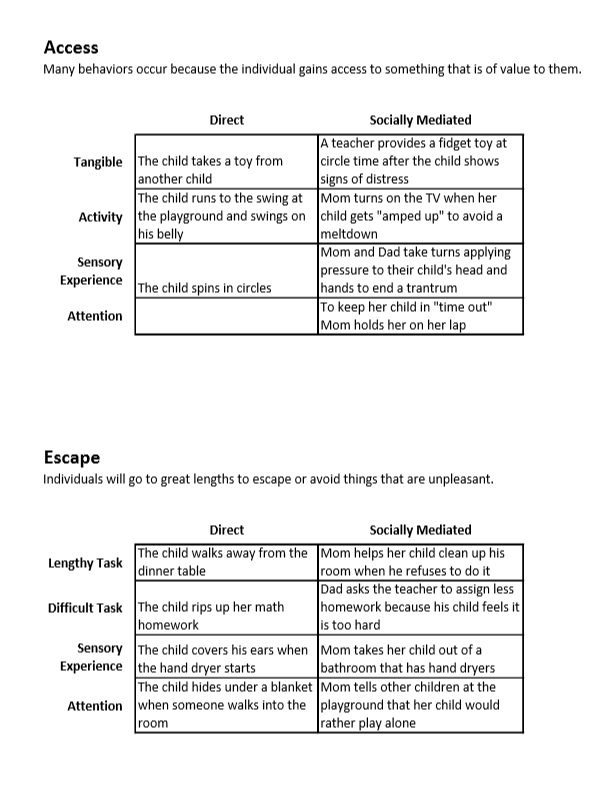
Cipani & Schock reorganized behavioral functions into two high-level categories:
Access (positive reinforcement)
Escape (negative reinforcement)
Then they further differentiated:
What type of reinforcer is involved?
(tangible, activity, sensory, attention)Is the reinforcer obtained directly or socially mediated?
(the distinction that truly matters for intervention)
This enables an analyst to write functional hypotheses with far more clarity, such as:
“Behavior is maintained by direct access to sensory stimulation.”
“Behavior is maintained by socially mediated escape from relatively lengthy tasks.”
“Behavior is maintained by socially mediated access to adult attention.”
“Behavior is maintained by direct escape from loud auditory stimuli.”
This clarity helps you select interventions that match the functional mechanism, not just the surface-level category.
It narrows your intervention options instead of leaving you with dozens of generic strategies.
This is why the Cipani model is powerful:
It forces you to describe what the child gets, how they get it, and why it works — all of which are required for a function-based plan.
Where Each Model Fits (and Why You May Use More Than One)
Different models are useful for different audiences:
Classic 4-function model
Great for parent-friendly explanations or introductory training.Cipani & Schock diagnostic model
Best for designing precise, function-based interventions.
You’re not picking one forever.
You’re choosing the right tool for the right context.
Your RBTs may need simplicity.
Your BIP must demand clinical precision.
Access-Maintained Behaviors
Access-maintained behaviors occur when an individual engages in a behavior to gain something—an item, an activity, a sensory experience, or attention. In other words, the behavior persists because it reliably produces access to something the learner wants or finds reinforcing. Access-maintained behaviors are incredibly common, especially among autistic learners who may have difficulty communicating their needs in more appropriate ways. When we correctly identify what the learner is trying to access, we can replace challenging behavior with effective, functional communication that meets the same need without the fallout.
Direct Access
Direct access behaviors are often deceptively simple on the surface—but they tell you a tremendous amount about what the learner values. When a learner can get the reinforcer themselves, they usually will, and they’ll do it through the most efficient behavior in their repertoire.
This is why direct access–maintained behaviors often become highly resistant to change unless you provide an alternative behavior that is equally easy and equally powerful.
Examples include:
A child grabbing a sibling’s tablet → direct access to the device
A learner running to the trampoline and beginning to jump → direct access to the activity
A teen turning on bright lights or tapping objects for sensory input → direct access to sensory reinforcement
Intervention for direct access almost always requires:
Instruction in an appropriate alternative (e.g., manding, waiting, sharing)
Environmental restructuring (e.g., limiting immediate access to powerful reinforcers)
Clear contingencies (access follows an appropriate behavior only)
This sets the stage for shifting behavior without creating unnecessary frustration.
Socially Mediated Access
Social mediation brings an added layer of complexity because someone else is involved—even when they don’t realize it.
When a reinforcer is delivered by another person, whether intentionally or accidentally, the learner quickly learns:
“If I do X, you will give me Y.”
Many socially mediated patterns start unintentionally and become deeply ingrained before anyone notices. Here’s how each subtype plays out in practice:
Socially Mediated Access to Tangibles
This often appears as:
whining or crying → parent hands over the desired item
hitting or grabbing → peer releases a toy
throwing materials → teacher provides a preferred replacement
The behavior persists because the path of least resistance works—for the learner and for the adult trying to get through the moment.
Socially Mediated Access to Activities
This might include:
screaming leading to being taken outside
property destruction leading to iPad time
yelling during transitions leading to extra playground minutes
Adults who are trying to prevent escalation often create an unintentionally strong reinforcement history.
Socially Mediated Access to Sensory Experiences
This usually involves activities the learner cannot produce independently:
deep pressure squeezes
spinning on a swing
joint compressions
rhythmic bouncing
When these are delivered in response to challenging behavior, the behavior becomes a reliable request—even if no words are used.
Socially Mediated Access to Attention
Attention is always socially mediated, which means it is always a potential reinforcer.
Remember: reprimands, lecturing, correcting, explaining, negotiating, and “just trying to help them calm down” are all attention.
And for attention-maintained behavior, any response—even negative—is reinforcement.
Escape-Maintained Behaviors
Escape is one of the strongest behavioral functions because humans naturally avoid discomfort. In ABA, escape-maintained behaviors occur when the behavior results in removal of something aversive.
These behaviors often look dramatic because they’re communicating a high level of distress, overwhelm, or skill deficits.
Escape-maintained behaviors fall into similar categories as access:
Escape from lengthy tasks
Escape from difficult tasks
Escape from aversive sensory input
Escape from social demands or attention
Let’s go deeper into each.
Escape From a Relatively Lengthy Task
“Long” is defined by the learner, not the adult.
Examples include:
leaving the table during meals
walking away during a long work session
refusing multi-step chores
engaging in tantrums when asked to complete prolonged tasks
When the adult reduces the task demand, the learner’s behavior is strengthened—even if the adult was simply trying to help.
Escape From a Relatively Difficult Task
Difficulty is subjective. Many academic and self-care tasks fit this category.
Examples:
tearing up a worksheet
putting head down during reading
refusing motorically challenging tasks
crying when presented with writing tasks
If the adult simplifies the task, completes parts of it, or removes it entirely, this becomes a strong escape contingency.
Escape From an Aversive Sensory Experience
This is especially common among autistic learners.
Examples:
covering ears
running from the room
screaming
pushing or grabbing adults
hiding under furniture
When the adult removes the sensory stimulus—or removes the learner from the environment—the escape response becomes more likely in the future.
Escape From Attention or Social Interaction
This is an important (and often misunderstood) category.
Some learners:
find praise aversive
find reprimands aversive
find social proximity uncomfortable
find interaction unpredictable or overwhelming
Behaviors may include:
avoiding eye contact
pushing others away
withdrawing or hiding
engaging in aggression when approached
When adults back away or stop interacting, the escape behavior is reinforced.
Direct Escape
This occurs when the learner can remove themselves from the aversive situation without assistance.
Examples:
leaving the table
running down the hallway
putting hands over ears
hiding under blankets
Direct escape behaviors are often fast, efficient, and highly practiced.
Socially Mediated Escape
Here, another person must complete the escape.
Examples:
adult reducing the workload
adult ending a task
adult removing the learner from a noisy environment
adult allowing the learner to opt out of a social interaction
This is one of the strongest behavioral patterns because adults often intervene quickly—especially when they’re trying to prevent escalation.
How Many Functions Are There, Really?
If you’ve been in ABA long enough, you’ve probably heard three or four “functions of behavior” depending on who’s talking. This inconsistency is a huge reason new practitioners get confused. The truth is far simpler—and deeper—than the classic lists make it seem.
Let’s cut through the noise.
The Traditional View: 3–4 Functions
Most textbooks, courses, and parent resources still teach the familiar categories:
Access
Escape
Attention
Automatic reinforcement
This model works for basic understanding, but it’s also imprecise. Notice that three of these four categories actually describe positive reinforcement, while only one describes negative reinforcement. That lack of symmetry is part of why many professionals eventually outgrow this model—it doesn't give enough detail to drive high-quality, function-based intervention.

The Best Model for Practice: Cipani & Schock (2010)
Cipani and Schock offer the most practical, precise, behavior-analytic framework. Their diagnostic system breaks function into three questions:
Is the behavior maintained by access (positive reinforcement) or escape (negative reinforcement)?
What type of reinforcer is involved? (tangible, sensory, activity, attention, reduction in task demand, etc.)
Is access to that reinforcer direct or socially mediated?
This creates a detailed picture of maintaining variables without the redundancy of traditional models.

Example:
A child hitting to avoid math work isn’t just “escaping.” Using the Cipani model, you might describe the behavior as:
Socially mediated escape from a relatively difficult task
This phrasing tells you exactly what to target:
the difficulty of the task,
the child’s skill deficits,
the adult’s response patterns,
and the appropriate replacement behavior to teach.
Why This Matters for Real Intervention
The more precisely we describe the function, the easier it becomes to:
pinpoint maintaining variables,
design replacement behaviors that truly match the function,
select the right antecedent strategies,
rule out interventions that won’t work,
and train staff and caregivers effectively.
In other words:
Precision in identifying function = precision in intervention = better outcomes.
Determining the Function of a Behavior
Identifying the function of a behavior isn’t guesswork—it’s a systematic process rooted in observable data, repeated patterns, and structured assessment. Even though our learners can’t always tell us why they engage in a behavior (and often wouldn’t know even if they could verbalize it), the environment leaves a trail of clues. Your job is to read that trail with precision.
Understanding function begins with one core question:
“What does this behavior get the learner, or what does it help the learner avoid?”
While that question sounds simple, the path to answering it requires multiple layers of evidence. You’re not just identifying the topography of the behavior—you’re uncovering the contingency that strengthens it. And the accuracy of that conclusion directly determines whether your intervention plan succeeds or fails.

Start With ABC Data
ABC data provides the first major lens into behavioral function. By documenting what happens before (A), during (B), and after (C) the behavior, you begin to identify the patterns that maintain it.
A single ABC entry offers context.
Multiple entries reveal a story.
Let’s walk through an example:
ABC Entry #1
Antecedent: Debra tells Jake it’s time for school
Behavior: Jake yells “no” and throws his toy
Consequence: Debra gasps; Jake delays leaving and misses the bus
On the surface, this is straightforward: Jake gains both a brief attention reaction and escape from the transition to school.
But behavior is rarely one-dimensional, and single instances can mislead. That’s why ongoing entries matter—antecedents become consequences for the next behavior, and escalating patterns often emerge:
ABC Entry #2
Antecedent: Delay from previous behavior; routine is disrupted
Behavior: Crying, stomping, pushes Debra
Consequence: Debra says, “We need to go—I’m going to be late,” increasing attention and pressure
ABC Entry #3
Antecedent: Maternal urgency and emotional tone
Behavior: Jake hits Debra and runs to his room
Consequence: Debra offers a donut to get him to leave the house
Across these entries, Jake’s behaviors create a predictable outcome: delaying or avoiding a transition he finds aversive while accessing high-value attention and, eventually, a tangible reinforcer.
Even without a formal analysis, the emerging pattern suggests a combination of escape and socially mediated access.
When ABC Data Isn’t Enough
Sometimes ABC patterns are clean and compelling. Other times, they’re muddy, inconsistent, or confounded by setting events you couldn’t observe.
In those cases, you supplement.
Use Questionnaires to Strengthen Your Hypothesis
Tools such as:
Motivation Assessment Scale (MAS)
Questions About Behavioral Function (QABF)
provide structured input from caregivers or staff, filtering through behavior patterns that may not be captured during observation. Research shows strong convergent validity between these tools and analogue functional analyses—which makes them credible additions to your data set.
Your goal is not to rely on these questionnaires alone but to triangulate their insights with your ABC patterns.
Use Scatterplot Data for Temporal Patterns
A scatterplot helps you answer questions like:
Does the behavior occur only in the morning?
Only during a specific class?
Only when a particular staff member is present?
Only after lunch or after a medication dose?
These temporal patterns often reveal setting events or conditional probability relationships you may have otherwise overlooked.

Download a Free Scatterplot Data Sheet and How To Use a Scatterplot Guide
Pulling It All Together: The Triangulation Process
Once you’ve collected:
ABC data
Questionnaire ratings
Scatterplot patterns
…it’s time to synthesize. Many BCBAs rely on a Data Triangulation Chart, which allows you to map the most common antecedents and consequences across all sources.

Download a Free Data Triangulation Chart.
You might note:
Most frequent antecedents
Most frequent consequences
Possible setting events
Predominant modes of access or escape
Inconsistencies worth exploring further
The goal is not perfection—it’s confidence.
You’re looking for the explanation that:
✔ fits the majority of the data
✔ explains the behavior most parsimoniously
✔ aligns with known reinforcement patterns
✔ is specific enough to guide a function-based intervention
Once you’ve identified the likely function using the traditional framework (Access vs. Escape) and refined your understanding through Cipani & Schock’s diagnostic model, you’re ready to build an intervention that directly competes with—and ultimately replaces—the maintaining contingency.
Conclusion
Understanding the function of behavior isn’t optional in ABA—it’s the backbone of ethical, effective, and compassionate intervention. When you move beyond surface-level descriptions and truly analyze why a behavior continues, you gain the power to design plans that actually work in the real world. Whether you lean on the simplicity of the traditional four-function model or the precision of Cipani & Schock’s diagnostic system, the goal is the same: identify the reinforcer, understand the contingency, and build interventions that honor the learner’s needs.
Function-based intervention isn’t about shutting behavior down. It’s about teaching with clarity, reinforcing more adaptive responses, and reducing frustration for everyone involved—learners, families, and practitioners alike. When you ground your decisions in high-quality data and a clear understanding of access and escape contingencies, you create interventions that produce lasting, meaningful change.
The work takes practice. The analysis takes thought. But once you sharpen your ability to determine function accurately, you unlock one of the most powerful tools in the ABA toolbox—and every other decision you make becomes smarter, kinder, and more effective.
References and Related Reading
Cipani, E., & Schock, K. M. (2010). Functional behavioral assessment, diagnosis, and treatment: A complete system for education and mental health settings. Springer Publishing Company.
Cooper, J. O., Heron, T. E., & Heward, W. L. (1987). Applied behavior analysis. Merrill Publishing Co.
Grey, I. M., & Hastings, R. P. (2005). Evidence-based practices in intellectual disability and behaviour disorders. Current opinion in psychiatry, 18(5), 469-475.
Jamison, W. J., Hard, A., B. A.,Tara, Allen, C., Clark, J. & Hagy, S. (2016). ABA in 2016. [PowerPoint slides].
Paclawskyj, Theodosia Renata, "Questions About Behavioral Function (QABF): A Behavioral Checklist for Functional Assessment of
Aberrant Behavior." (1998). LSU Historical Dissertations and Theses. 6855. https://digitalcommons.lsu.edu/gradschool_disstheses/6855
T. R. Paclawskyj,, J. L. Matson,, K. S. Rush,, Y. Smalls, T. R. Vollmer. (2008). Assessment of the convergent validity of the Questions About Behavioral Function scale with analogue functional analysis and the Motivation Assessment Scale. Journal of Intellectual Disability Research. https://doi.org/10.1046/j.1365-2788.2001.00364.x


