What to Include in an ABA Parent Training Note
What to Include in an ABA Parent Training Note
Parent training notes can be surprisingly difficult to write.
It is easy to document that you met with a parent, discussed a strategy, answered questions, and reviewed the child’s progress. But that does not necessarily show what actually happened during parent training.
A strong parent training note should make it possible for someone who was not in the session to understand what the caregiver was working toward, what the BCBA did to support that goal, what the caregiver actually did, what the session revealed about progress or barriers, and what happens next.
That makes the note more useful clinically. It also creates a much clearer record when an insurance reviewer needs to determine whether the service delivered matches the service billed and whether the caregiver is making progress.
Important: Documentation requirements vary by payer, state, benefit plan, and organization. The examples in this article illustrate strong clinical documentation but do not replace the requirements that apply to your specific services (Blue Cross and Blue Shield of Illinois, 2026; North Carolina Medicaid, 2026).
What are insurance companies looking for in a parent training note?
There is no single note format required by every insurance company, but current payer guidance shows some consistent expectations.
BCBS Illinois describes CPT 97156 as family adaptive behavior treatment guidance provided by a qualified health professional to a parent or caregiver, with or without the patient present. Its documentation guidance also identifies information such as the service provided, provider information, date, beginning and ending times, a written account of the service, and data related to progress as information that may be needed to substantiate ABA services (Defense Health Agency, 2025; Blue Cross and Blue Shield of Illinois, 2026).
TRICARE similarly defines 97156 as guidance provided to parents or caregivers so they can use treatment-plan protocols, with or without the beneficiary present (Defense Health Agency, 2025).
North Carolina Medicaid currently adds a more specific requirement: when 97156 includes both caregiver-only time and time with the caregiver and beneficiary together, the documentation must clearly differentiate those periods (North Carolina Medicaid, 2026).
And what insurers ask for at continued authorization gives another clue about what your session notes need to build over time. Aetna’s current ABA precertification materials call for measurable caregiver goals and baseline, interim, and current data (Aetna, 2026). UnitedHealthcare’s ABA review form asks about caregiver proficiency with ABA techniques and the amount of parent training provided (UnitedHealthcare Community Plan of Tennessee, 2024).
Taken together, your documentation should make several things clear:
which caregiver or treatment-plan goal was addressed;
what the BCBA actually taught, modeled, coached, reviewed, or problem-solved;
what the caregiver actually did during the session;
what measurable or observable information was obtained;
what that information means clinically; and
what the next step will be.
A note that only says “parent training completed” or “reviewed reinforcement with parent” does not tell the reviewer much about the service that occurred.
Start with a measurable parent training goal
Writing the note becomes much easier when the caregiver goal is measurable.
Consider this goal:
Parent will understand reinforcement.
What would you document to show progress?
Did the parent identify an effective reinforcer? Deliver reinforcement at the correct time? Choose an item based on current motivation? Implement the strategy independently during a routine?
Those are different skills, and they require different teaching and different data.
A measurable goal gives you something specific to teach, observe, practice, and document.
If your caregiver goals are difficult to measure, your parent training notes will usually be difficult to write too. See How to Write Measurable ABA Parent Training Goals for a deeper look at building goals that give you meaningful information from session to session.
Use SOAP to organize the information
The ACHIEVE Session Companion uses a SOAP structure because it helps make sure the important information gets captured during the session.
That does not mean your final EHR note needs to be divided into four labeled sections.
The completed note can read as one narrative paragraph while still including the same components.
Subjective captures what the caregiver reports. This could include what happened since the last session, whether the strategy was used, what worked, what was difficult, changes in routines, or a new concern.
Objective captures what happened during the session. What did BCBA teach, model, coach, review, or problem-solve? What did the caregiver practice? What observable data or performance information were collected?
Assessment explains what that information means clinically. Does the caregiver need more explanation? More practice? Is the caregiver able to perform the skill, but the plan does not fit the family’s routine? Did the session identify a barrier that requires a change in the plan?
Plan identifies what happens next. What will the caregiver try before the next session? What will BCBA reassess, review, or coach next time?
Thinking through those four components helps keep the note from becoming a list of topics discussed.
Use names to make the note clearly individualized
Using the actual names of the people involved can make the note much more obviously specific to the client and family.
Compare:
Mother practiced prompting with client.
with:
Maria practiced the prompting sequence with Eli.
The second version makes it much clearer who did what.
Use the caregiver’s actual name, the client’s actual name, and the names of other participants when relevant. BCBA can remain in third person:
BCBA modeled the procedure for Maria.
The names used in the examples below are fictional.
Example 1: Teaching and practicing a communication strategy
Here is what the completed note might look like in the EHR:
Maria reported that Eli continues to pull her toward preferred items when he wants something and that she is not always sure when to prompt his communication response. BCBA addressed Maria’s caregiver goal of prompting Eli to request a preferred item before providing access. BCBA reviewed and modeled the prompting sequence, then had Maria practice across five role-play opportunities. Maria completed 4 of 5 steps independently and required one prompt to wait for Eli’s communication response before providing the item. Maria demonstrated improved independence with the procedure compared with the previous session. She identified snack time and tablet access as two routines where she can practice the strategy this week. Maria will practice during those routines, and BCBA will review implementation and provide additional coaching during the next parent training session.
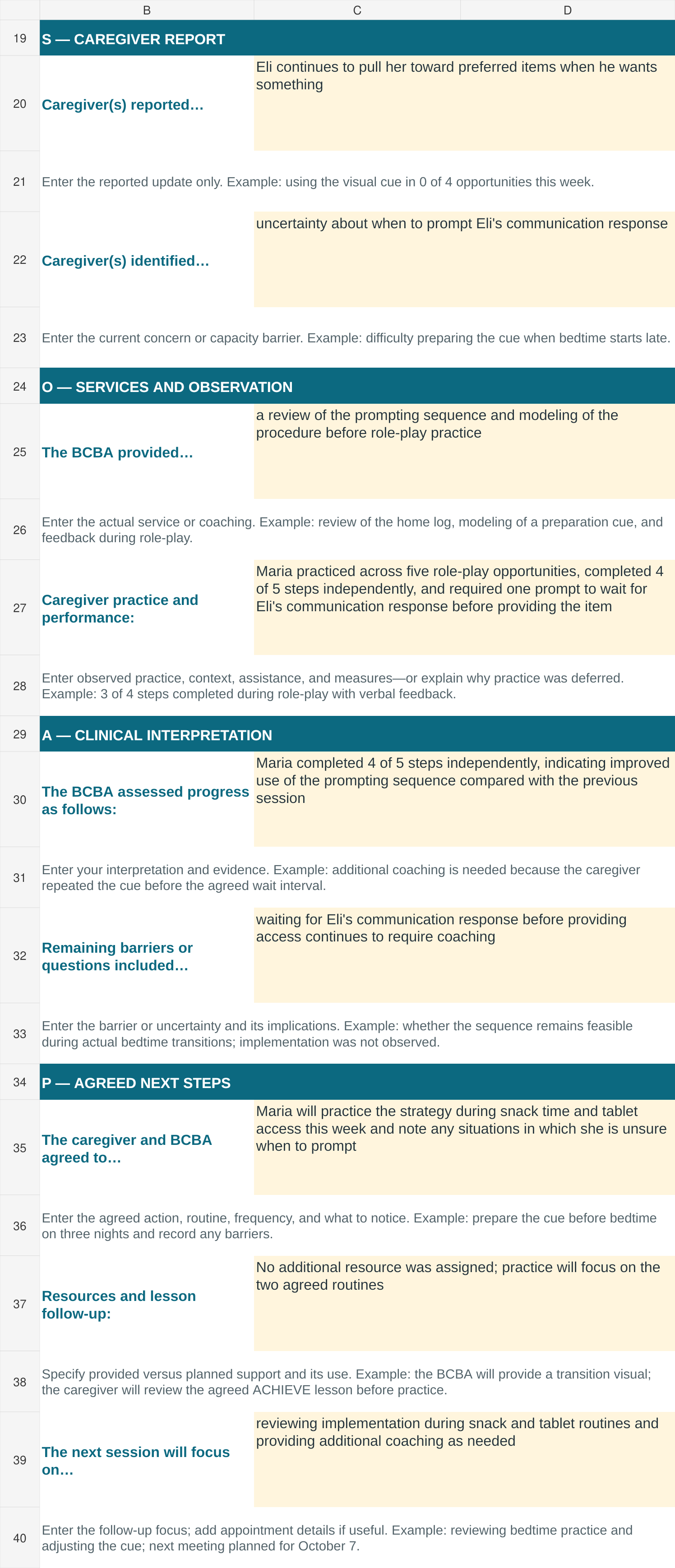
The note shows what Maria reported, the goal addressed, what BCBA did, what Maria practiced, how she performed, what still required coaching, and what happens next.
Compare that with:
Reviewed functional communication training with parent. Discussed prompting and answered questions. Parent verbalized understanding.
The second note tells you the topic, but it does not tell you whether the caregiver can actually use the strategy.
“Verbalized understanding” is especially limited if the goal involves doing something. Someone can understand a strategy without being able to implement it accurately during a real routine.
Example 2: Coaching during an actual routine
Daniel reported that Noah is more likely to leave the table when directions are given during dinner and that Daniel often repeats the direction several times. BCBA addressed Daniel’s caregiver goal of delivering one clear direction, allowing adequate response time, and reinforcing completion. BCBA modeled the procedure during the dinner routine and then coached Daniel across four naturally occurring opportunities. Daniel independently implemented all targeted steps in 3 of 4 opportunities. BCBA provided feedback on reducing repeated directions, and Daniel incorporated the feedback correctly during the final two opportunities. Daniel demonstrated increased independence with the procedure, although waiting for Noah to respond before repeating the direction continues to require attention. Daniel will continue practicing during dinner, and BCBA will reassess independence during the next session.
Simply documenting that Daniel “participated in parent training” would not show what he actually did.
This note documents observable caregiver behavior. Daniel practiced the procedure, implemented the steps independently in 3 of 4 opportunities, responded to feedback, and improved during the session.
That gives you something meaningful to compare with future sessions.
Example 3: The parent knows what to do, but the plan does not fit
Not every implementation problem means the parent needs more training.
Sometimes the caregiver understands the strategy and can demonstrate it correctly, but the plan does not work well within the family’s actual routine.
Maria reported using Ava’s visual schedule on 1 of the previous 5 school mornings. Maria stated that preparing and reviewing the full schedule takes too much time while she is also getting Ava’s siblings ready for school. BCBA reviewed the current procedure with Maria, who accurately described and demonstrated all steps independently. BCBA and Maria reviewed the morning routine and modified the schedule from a full sequence to three steps that can remain posted near the door. Maria practiced the revised procedure independently across two role-play opportunities and reported that the modification seemed manageable within the morning routine. Maria’s performance indicated that lack of understanding or skill was not the primary barrier to implementation. Maria will use the revised three-step visual during the morning routine this week. BCBA will review implementation, barriers, and Ava’s response during the next parent training session.
This is why documenting that a caregiver simply needs to “be more consistent” often does not give you enough information.
Maria knew the procedure. She could demonstrate it independently.
The session identified a different problem: the original plan required more time and preparation than was practical during the morning routine.
The clinical response should be different when the problem is fit rather than knowledge or skill.
Example 4: A new concern comes up during parent training
Parent training needs enough structure to show progress over time, but that does not mean you ignore what happened at home this week.
A new concern can still become structured clinical work.
Daniel reported that Liam has recently cried, yelled, and attempted to regain the tablet when tablet access ends, most often immediately before dinner. BCBA reviewed recent examples with Daniel and identified that tablet removal typically occurred without advance warning. BCBA taught Daniel to provide a brief transition warning and prompt Liam’s existing request for one additional minute when appropriate. Daniel practiced the procedure across three role-play scenarios and implemented all steps independently in 2 of 3 opportunities. Daniel required feedback during one practice opportunity but then demonstrated the revised procedure correctly. The family will use the transition procedure before dinner and track whether Liam uses the communication response before escalation. BCBA will review the results during the next session.
The parent’s concern shaped the session, but the note still shows a clinical process.
Information was gathered. A strategy was selected. Daniel practiced it. His performance was observed. A plan was made for what to try next.
That is very different from:
Parent reported problems with tablet removal. Discussed transitions and answered questions.
Example 5: The child is not present
Family adaptive behavior treatment guidance can be provided with or without the beneficiary present, depending on the applicable payer requirements (Defense Health Agency, 2025).
A caregiver-only session can still include active teaching, practice, measurement, and clinical decision-making.
Maria reported difficulty deciding when to prompt Sophia to request a break versus when to discontinue a task because Sophia is becoming upset. BCBA reviewed three recent situations described by Maria and taught criteria for prompting Sophia’s existing break request. Maria identified an appropriate opportunity to prompt the communication response in 4 of 5 written scenarios. Maria initially had difficulty distinguishing between prompting a break request and ending the task following escalation. BCBA provided additional examples and feedback, after which Maria responded correctly across three consecutive scenarios. Maria demonstrated improved discrimination of when to prompt the break request, although application during naturally occurring routines has not yet been assessed. BCBA will review Maria’s use of the strategy during home routines at the next session and provide in-context coaching as appropriate.
Sophia did not need to be present for the note to show what Maria was learning and how she responded to instruction.
Parent training data should tell you whether the caregiver is making progress
If Maria’s goal is to prompt Eli’s communication response, Eli’s behavior is relevant.
But Eli’s data alone do not tell you whether Maria learned the skill.
Depending on the goal, caregiver progress might be reflected in the number of steps completed independently, accuracy during practice, implementation during naturally occurring opportunities, the amount of coaching required, use of the strategy between sessions, or changes in barriers affecting implementation.
The measure should match the caregiver goal.
That becomes especially important at reauthorization. Aetna’s current requirements specifically call for measurable caregiver goals and baseline, interim, and current data across goals. UnitedHealthcare’s ABA review materials ask providers to report caregiver proficiency with ABA techniques and the amount of parent training provided (Aetna, 2026).
If six months of notes say only “parent attended,” “parent verbalized understanding,” or “reviewed strategies with parent,” it can be difficult to demonstrate what changed.
Make sure the note shows caregiver treatment guidance
Updating a parent about the child’s progress may be part of a session.
But if the service being billed is family adaptive behavior treatment guidance, the documentation should make the caregiver-training component clear.
Compare:
BCBA reviewed Noah’s progress with Daniel and discussed recent behavior. Daniel asked questions and verbalized understanding.
with:
BCBA reviewed Noah’s recent difficulty transitioning from tablet access with Daniel and taught Daniel to provide a transition warning and prompt Noah’s existing communication response. Daniel practiced the procedure across three scenarios and implemented all steps independently in 2 of 3 opportunities.
The second example makes it much easier to see what Daniel was learning and what BCBA did to support that learning.
Document what happens next
A clear plan creates continuity from one session to the next.
It does not need to be complicated.
“Maria will practice during snack and tablet routines. BCBA will review implementation next session.”
“Daniel will track whether Liam uses the communication response before escalation.”
“BCBA will observe Maria implementing the procedure during the morning routine to determine whether additional modification is needed.”
Each of those gives the next session somewhere to start.
Without that continuity, parent training can easily become a series of unrelated conversations based on whatever happened most recently.
Strong parent training notes do not have to be long
A longer note is not automatically a better note.
A strong note should give enough information to answer four questions:
What was the caregiver working on?
What happened during the session?
What did the session tell you?
What happens next?
When those pieces are clear, the note does more than prove that a session occurred. It creates a record of caregiver progress that can guide future sessions and support treatment decisions and continued authorization.
Make the note easier by capturing the information during the session
Documentation often takes longer when you wait until after the session and try to reconstruct everything that happened.
The ACHIEVE Session Companion was designed to help you capture the information you will need while the session is happening.
You can use it before the session to identify the focus, during the session to record caregiver report and performance, and afterward to turn those details into a SOAP-based narrative note.
It also helps you keep the next step visible so the following parent training session does not have to start from scratch.
Download the Free ACHIEVE Session Companion
A final reminder about payer requirements
The examples in this article show one way to document parent training clearly and clinically.
They are not a universal insurance template.
Requirements can differ across payers. BCBS Illinois, for example, identifies specific service-verification information that may be requested, while North Carolina Medicaid has specific rules for documenting caregiver-only versus caregiver-plus-beneficiary time under 97156 (Blue Cross and Blue Shield of Illinois, 2026).
Check the documentation requirements for the payer you are billing, along with your organization’s policies and applicable state requirements.
The goal is not to make every parent training note look identical.
The goal is to make it clear what happened, what the caregiver is learning, whether progress is occurring, and what comes next.
References
Aetna. (2026). Outpatient Behavioral Health (BH) – ABA Treatment Request: Required Information for Precertification (Form GR-69017-4). Aetna ABA Treatment Request for Precertification
Blue Cross and Blue Shield of Illinois. (2026). Applied Behavioral Analysis: Clinical Payment and Coding Policy CPCP011 (effective March 20, 2026). BCBSIL Applied Behavioral Analysis Policy CPCP011
Defense Health Agency. (2025). TRICARE Operations Manual 6010.59-M, Chapter 18, Section 4: Department of Defense Comprehensive Autism Care Demonstration. TRICARE Operations Manual, Chapter 18, Section 4
North Carolina Medicaid. (2026, October 12). Concurrent Billing Clarification for Research-Based Behavioral Health Treatment. NC Medicaid concurrent billing clarification
UnitedHealthcare Community Plan of Tennessee. (2024). Request for Applied Behavior Analysis (ABA): ABA UM Service Request Form. UnitedHealthcare Community Plan of Tennessee ABA Request Form


