
How to Write Measurable ABA Parent Training Goals
A measurable parent training goal should tell you what the caregiver is working toward and what you will actually be able to observe.
But measurement should not be the first step.
Before deciding what a parent should learn, you need to know what matters to that family, what they are trying to make easier or better, and what is getting in the way. A technically perfect goal is not very useful if it addresses something the BCBA chose but the parent does not see as important.
The strongest ABA parent training goals are developed collaboratively with caregivers, connected to meaningful family routines, and written around something the caregiver can actually do.
That also makes the rest of parent training easier. When the goal is clear, you have something specific to teach, practice, measure, and document. If your caregiver goals are vague, your session notes will usually be vague too. For examples of how measurable goals translate into documentation, see What to Include in an ABA Parent Training Note.
Start with the family’s problem, not a goal bank
It is tempting to start with a list of common parent training goals:
Use reinforcement correctly.
Give effective instructions.
Implement the visual schedule.
Use the communication plan with fidelity.
Any of those might eventually become an appropriate goal.
But first, find out what the family actually wants help with.
A parent may say:
“Bedtime takes two hours.”
“I can’t get him out of the house in the morning.”
“She gets so upset when screen time ends.”
“I don’t know what to do when he starts pulling me toward things.”
Those concerns give you somewhere useful to start.
Caregiver-mediated interventions are more likely to be meaningful when they fit the family’s routines, context, and preferences rather than asking caregivers to implement procedures that were designed without that context in mind (O’Neill & Koudys, 2025).
The job of the BCBA is not to replace the parent’s concern with a clinical goal. It is to work with the parent to understand the concern and identify a caregiver skill that could help move the family toward what they want.
Use the ACT Matrix to identify values and barriers
The ACT Matrix can be useful before a goal is written because it gives you a way to talk about what matters to the parent and what may be getting in the way.
Instead of immediately asking, “What strategy should we teach?” you can explore questions such as:
Who and what matters most to you?
What would you like this part of family life to look more like?
What difficult thoughts, feelings, or worries show up?
What do you tend to do when those thoughts and feelings are present?
What could you do that would move you closer to what matters?
That information can change the goal considerably.
For example, imagine a parent starts with:
“Bedtime is awful. I just want evenings to feel calmer.”
The ACT Matrix might reveal that the parent values calm evenings, connection with their child, enough sleep, less conflict, and having a little time to recharge after bedtime.
At the same time, the parent may be exhausted, worried that setting a limit will make the situation worse, and feeling guilty when the child becomes upset. When those feelings show up, the parent may delay starting bedtime, allow extra screen time, or finish parts of the routine for the child.
Now there is much more information available than “parent needs to be more consistent.”
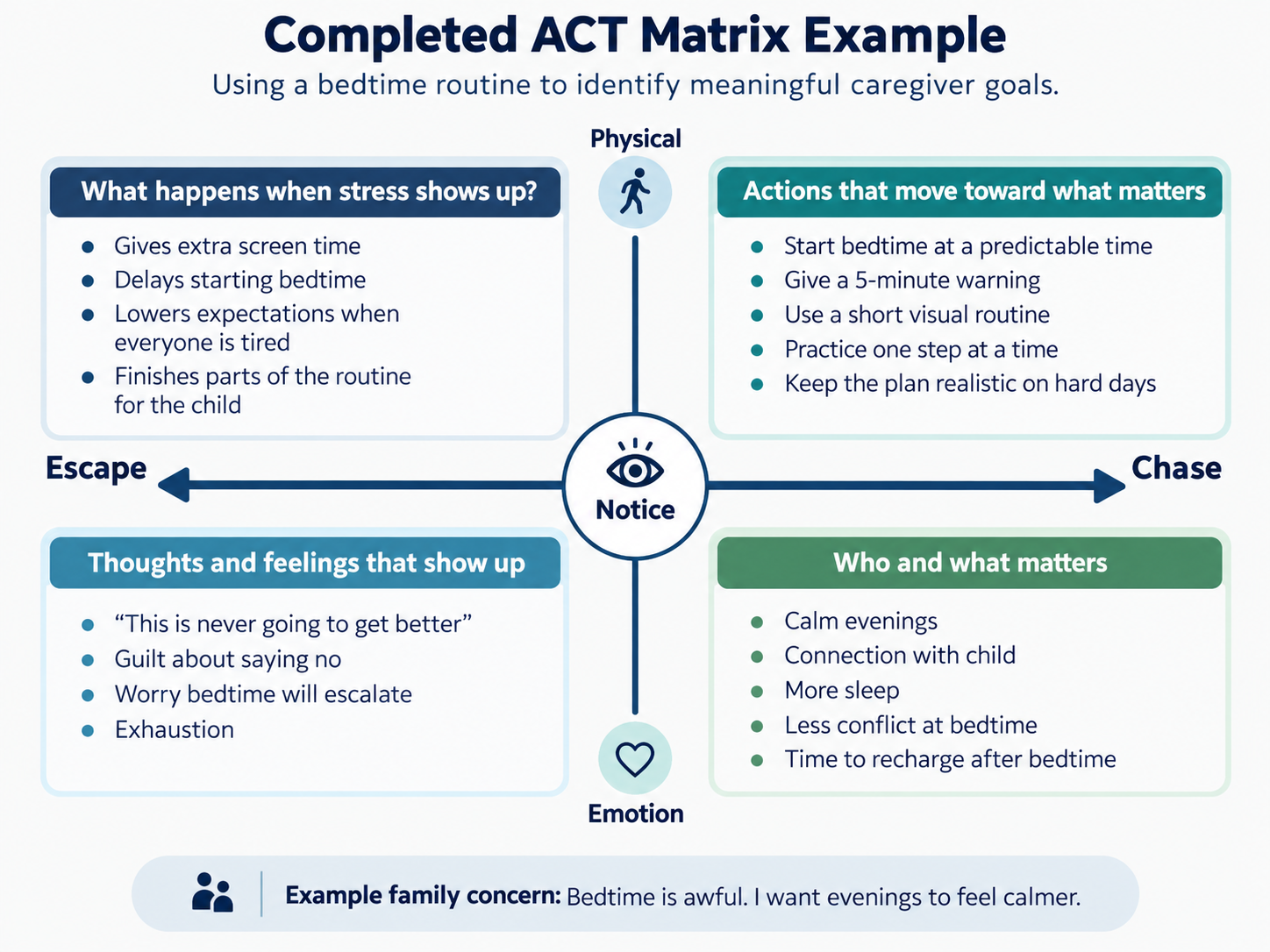
The goal can then be developed around something the parent believes will move the family toward what matters.
For example:
During the bedtime routine, Maria will provide the agreed 5-minute transition warning and use the three-step visual routine independently on at least 4 of 5 evenings per week for two consecutive weeks, measured through caregiver self-monitoring and reviewed with BCBA.
The strategy still needs to be tested and adjusted based on how it works for this family, but the goal now has a reason for existing.
It came from the family’s concern and values rather than from a generic parent training goal bank.
Decide what success would actually look like
Once you know what the family wants help with, ask:
What would the caregiver need to be able to do differently for this situation to improve?
That is often where a parent concern becomes a caregiver goal.
If the concern is:
“He gets really upset when I ask him to stop using the tablet.”
the caregiver skill might involve giving a transition warning, using a visual, recognizing an appropriate opportunity to prompt communication, or changing how the transition is arranged.
If the concern is:
“She pulls me everywhere because she can’t tell me what she wants.”
the caregiver skill might involve recognizing communication opportunities and prompting an existing AAC response.
If the concern is:
“I don’t know what to do when he says no.”
the caregiver skill might involve recognizing assent withdrawal and knowing when to pause, offer a choice, or adjust the task.
The caregiver goal should describe what the caregiver needs to learn, not simply restate the child goal.
Write the goal about caregiver behavior
Consider this goal:
Parent will understand reinforcement.
What exactly would you observe?
The caregiver might need to identify something likely to function as a reinforcer. Or deliver it immediately after a particular response. Or notice when something that was reinforcing yesterday is no longer valuable today.
Those are different skills.
Instead of writing:
Maria will understand reinforcement.
you might write:
Given five examples of potential reinforcers, Maria will identify an item or activity likely to be reinforcing based on Eli’s current preferences in at least 4 of 5 scenarios.
If the problem is implementation rather than identification, the goal could be:
During naturally occurring teaching opportunities, Maria will deliver the identified reinforcer within 3 seconds of Eli’s target response in at least 80% of observed opportunities across three sessions.
Both goals involve reinforcement, but they require different teaching and different measurement.
Get a baseline before teaching
Before deciding what the caregiver needs to learn, watch what they already do.
A parent may already have most of the skill.
For example, a BCBA observing a parent giving instructions might find that the parent:
gets the child’s attention,
states the instruction clearly,
uses appropriate language,
but begins helping almost immediately instead of allowing time for the child to respond.
There is no reason to train all four components equally if only one is creating difficulty.
A baseline helps narrow the goal and gives you something meaningful to compare with future performance.
Payer expectations also reinforce the importance of measurable caregiver goals and baseline data. Aetna’s current ABA precertification materials call for measurable caregiver goals that support intervention and generalization and request baseline, interim, and current data for treatment goals (Aetna, 2026).
Include the parts that make the goal measurable
A useful parent training goal usually identifies five things:
Component | What it tells you | Example |
|---|---|---|
Condition | When or where the skill should occur | During the bedtime routine |
Caregiver behavior | What the caregiver will actually do | Give a warning and show the visual |
Criterion | How well or how often | 4 of 5 opportunities |
Measurement | How progress will be assessed | Direct observation, fidelity checklist, self-monitoring, scenarios |
Durability | What shows that the skill is established | Across three sessions, two weeks, or another meaningful period |
Some payer guidance gets very specific about this. The Massachusetts standard ABA authorization form hosted by Aetna states that caregiver goals should identify the caregiver behavior expected, the condition under which it should occur, mastery criteria, baseline, progress data, and a generalization plan (Aetna, 2025).
That does not mean every payer requires goals to be written in exactly the same format. Requirements vary. But clinically, these components make the goal much easier to teach and measure.
Eight examples of measurable parent training goals
The numbers in these examples are illustrations, not universal standards. Criteria should be selected based on the skill, risk involved, current baseline, family context, and applicable payer requirements.
Honoring assent. During a 10-minute play or daily-living routine, Maria will respond to Eli’s identified assent-withdrawal signals, such as turning away, pushing materials away, saying “no,” or using his device to say “stop,” within 5 seconds by pausing the demand and offering a choice or break in at least 4 of 5 observed opportunities across 3 consecutive sessions.
Clear instructions. During routines such as dressing or cleanup, Daniel will get Noah’s attention, state the instruction once rather than phrasing it as a question, and wait at least 5 seconds before helping in at least 80% of observed opportunities across 3 consecutive routines.
Behavior-specific reinforcement. During a 10-minute shared activity, Maria will deliver behavior-specific praise or another agreed reinforcer within 3 seconds of Eli’s target response in at least 80% of identified opportunities across 3 consecutive observed sessions.
Following a task analysis. Daniel will teach Noah to wash his hands using the agreed task analysis and prompting plan with at least 85% fidelity on the individualized implementation checklist across 3 consecutive probes.
Preparing for transitions. Before identified daily transitions, such as leaving the park, ending screen time, or beginning bedtime, Maria will provide the agreed transition warning and show the first-then visual on at least 4 of 5 targeted days per week for 2 consecutive weeks, measured through caregiver self-monitoring and periodic BCBA observation.
Aided language modeling. During a 10-minute snack routine, Daniel will model agreed words on Noah’s AAC device at least 10 times without requiring imitation or a response from Noah across 3 consecutive observed sessions.
Creating communication opportunities. During snack or play, Maria will arrange at least 5 natural opportunities for Eli to communicate and wait at least 5 seconds before providing assistance in at least 4 of 5 observed opportunities across 3 consecutive sessions.
Independent problem solving. When a new challenge is discussed, Daniel will describe the situation, identify a reasonable hypothesis about what may be affecting the behavior, and identify one strategy consistent with the treatment plan to try without BCBA prompting in at least 3 of 4 opportunities across 4 weeks.
The important part is not the percentage.
It is that another clinician could read the goal and understand what the caregiver is expected to do and how you will know whether progress occurred.
Not every goal should measure the same thing
Fidelity is useful when the caregiver is learning a procedure with multiple steps.
But not every caregiver goal needs to be written as:
Parent will implement the intervention with 80% fidelity.
Sometimes the skill is discrimination.
Given examples of recent situations, Maria will identify when to prompt Eli’s break request in 4 of 5 scenarios.
Sometimes it is selection.
Given three potential strategies, Daniel will select the strategy that matches the identified barrier in 4 of 5 examples.
Sometimes it is implementation.
During naturally occurring communication opportunities, Maria will use the agreed prompting procedure independently in at least 80% of observed opportunities.
Sometimes it is problem solving.
When a new routine becomes difficult, Daniel will identify the problem, describe a likely barrier, and select an appropriate strategy without BCBA prompting.
The measurement should match the behavior in the goal.
Know, Do, or Fit?
When a caregiver is not using a strategy, more training is not automatically the answer.
It can help to ask whether the issue is Know, Do, or Fit.
If the caregiver does not understand the strategy or cannot identify when to use it, the need may be Know.
If the caregiver understands it but cannot yet implement it accurately, the need may be Do.
If the caregiver understands the strategy and can perform it but it does not work well within the family’s routine, capacity, priorities, or environment, the problem may be Fit.
Consider a parent who can demonstrate every step of a visual-schedule procedure during parent training but uses it on only one school morning that week.
It would be easy to conclude that the parent needs to be more consistent.
But if the parent is getting three children ready for school, preparing the schedule every morning takes ten extra minutes, and the current version is rarely where they need it, more BST probably will not solve the problem.
The plan may need to change.
Perhaps a three-step visual can remain posted near the door. Perhaps the routine needs fewer steps. Perhaps the strategy is simply not worth the effort it requires from this family.
Lack of implementation is data.
It should lead to assessment, not blame.
Choose realistic criteria
There is nothing magical about 80%, 85%, or three consecutive sessions.
Those numbers may be appropriate for a particular goal, but they should not be copied automatically from one treatment plan to another.
A safety-critical skill may require a much higher level of accuracy than a strategy being introduced during one low-risk routine.
A parent working two jobs and managing several children may need a goal that starts with one routine rather than expectations across the entire day.
A caregiver who is already close to mastery may need a narrower goal than someone learning a completely new procedure.
Avoid making 100% performance the default simply because it sounds rigorous.
The criterion should tell you when the caregiver has enough skill and independence for the goal you are actually addressing.
Break complex skills into a fidelity checklist
Some caregiver skills are too complex to measure as a single behavior.
“Implement the behavior support plan” is a good example.
If the plan includes five different steps, use a checklist.
Then you can see that the caregiver may independently complete steps 1, 2, 3, and 5 but consistently miss step 4.
That makes the next coaching decision much easier.
It also produces more useful documentation than simply stating that the caregiver used the plan “with moderate fidelity.”
Use behavioral skills training when the caregiver needs to learn a skill
When the goal involves performing a new skill, behavioral skills training provides a useful structure: instruction, modeling, rehearsal, and feedback.
A recent scoping review of caregiver training in ABA-based interventions found that BST or all four BST components were commonly used across the caregiver-training literature, and the authors recommend empirically supported caregiver-training approaches such as BST to support caregiver skill acquisition (O’Neill & Koudys, 2025).
ACHIEVE content can support the instruction portion of that process, but completing a lesson is not the caregiver goal.
Some parents may review an ACHIEVE lesson independently. Others may go through it with the BCBA during a session and return to it later as a reference.
The BCBA can then model the skill, give the caregiver an opportunity to practice it, and provide immediate, specific feedback.
The curriculum supports the teaching.
The measurable goal tells you whether the caregiver can use what was taught.
Build generalization and maintenance when they actually matter
Generalization should be planned intentionally, but it should also make sense for the family.
A handwashing skill may eventually need to work in multiple bathrooms.
A transition strategy may need to work when both parents are present.
A communication strategy may need to be used during play, meals, and community activities.
But not every caregiver goal needs two settings, three people, and five routines written into the mastery criteria.
Ask where the skill actually needs to work for this family.
Then build those conditions into the goal or into later generalization targets.
Current payer criteria commonly expect treatment plans to address maintenance and generalization of acquired skills, but those plans should still be individualized rather than copied from a template (Evernorth, 2024).
Keep checking whether the goal still fits
Collaboration should not end once the parent signs the treatment plan.
Keep asking whether the goal still matters.
Is the strategy helping?
Does it fit the routine?
Is the effort required reasonable?
Has something changed in the family’s life?
Does the parent still want to work on this?
If a caregiver repeatedly does not use a strategy, that should trigger curiosity.
Maybe they need more explanation.
Maybe they need practice.
Maybe the strategy takes too long.
Maybe another caregiver disagrees with it.
Maybe the child’s response makes the procedure difficult to sustain.
Maybe the family no longer thinks the goal is important.
The answer determines what the BCBA should do next.
Write a clinical version and a family version
The treatment plan may need a formal measurable goal:
During the bedtime routine, Maria will provide the agreed 5-minute transition warning and use the three-step visual independently on at least 4 of 5 evenings per week for two consecutive weeks.
The family version can be much simpler:
Give the warning and use the three-step bedtime visual most evenings.
The second version gives the parent something easy to remember and recognize.
The first gives the treatment team something measurable.
They are describing the same skill.
Attendance and lesson completion are not caregiver outcomes
A goal such as:
Caregiver will attend 90% of parent training sessions.
may be useful as an administrative expectation, but it does not tell you whether the caregiver learned anything.
The same is true of:
Parent will complete six ACHIEVE lessons.
Lesson completion is an intervention activity.
The outcome is what the caregiver can do afterward.
Did they identify an appropriate strategy?
Recognize an opportunity to prompt communication?
Use the procedure accurately?
Adjust their response based on what happened?
Solve a new problem with less BCBA support?
Keeping that distinction clear makes caregiver progress easier to see and makes parent training easier to justify clinically.
The long-term goal is not dependence on the BCBA
The eighth example above—independent problem solving—is important because caregiver training should eventually help parents make more decisions without needing the BCBA to solve every new problem.
That does not mean turning parents into behavior analysts.
It means helping them understand their child, recognize useful patterns, evaluate whether a strategy fits, and make reasonable decisions when the BCBA is not sitting beside them.
A caregiver who can say:
“This seems harder on mornings when we are rushed. I think the visual is helping, but five steps is too much. Could we shorten it?”
is giving you much more useful information than a caregiver who has simply memorized a list of ABA terms.
Measurable goals make documentation easier
A good caregiver goal also gives you something concrete to document.
If Maria’s goal specifies that she will complete a prompting sequence independently, your note can document how many opportunities occurred, which steps she completed, where she needed coaching, whether performance changed, and what happens next.
If the goal only says:
Parent will understand communication training.
there is much less to measure.
For examples of how these goals translate into actual EHR documentation, see What to Include in an ABA Parent Training Note.
Use the Session Companion to connect the goal to the session
Once a measurable caregiver goal is in place, each parent training session should move that goal forward or give you information that changes the plan.
The free ACHIEVE Session Companion gives you a place to identify the focus before the session, capture what the caregiver reports, track practice and performance, identify barriers, and organize the information needed for the note afterward.
Download the Free ACHIEVE Session Companion
The goal is not to make parent training more rigid.
It is to make sure the parent knows what they are working toward, the BCBA knows what to teach and measure, and both can tell whether the support is actually helping the family.
References
Aetna. (2025). Massachusetts Standard Form for Applied Behavior Analysis Services Prior Authorization Requests (Form GR-69758). Aetna.
Aetna. (2026). Outpatient Behavioral Health (BH) – ABA Treatment Request: Required Information for Precertification (Form GR-69017-4). Aetna.
Evernorth. (2024). Intensive Behavioral Interventions: Coverage Policy EN0499. Evernorth Behavioral Health.
O’Neill, P., & Koudys, J. (2025). Scoping review: Caregiver training to reduce challenging behaviors displayed by children on the autism spectrum. Behavior Analysis in Practice, 18(1), 56–73. https://doi.org/10.1007/s40617-024-00960-y


