Why Parent Training Becomes Reactive—and How to Give It More Structure
Parent training can get pulled off course in the first few minutes.
A parent comes in with something that happened this week. Bedtime fell apart. The child started climbing to reach something. School called. A strategy that seemed fine last week suddenly stopped working.
Those things matter. Sometimes the new problem really should become the priority for the session.
The problem is when every new concern replaces whatever the family was already working on.
Then parent training can turn into a series of useful conversations without much continuity. The parent brings a problem. The BCBA gives suggestions. Everyone moves on. A week later, a different problem takes over.
That can make it difficult to tell what the caregiver is actually learning, what has changed, or what the next session is supposed to build on.
The research on caregiver coaching suggests a better balance. Good coaching is collaborative and responsive to what is happening in the family’s life, but it also includes practice, feedback, reflection, problem solving, and a plan for what happens next. Those pieces create a coaching cycle rather than a series of unrelated conversations. (Pellecchia et al., 2022; Frost & Ingersoll, 2025).
What effective caregiver coaching actually includes
One useful way to think about structure is to look at the components of caregiver coaching that have been identified across the literature.
Pellecchia and colleagues described five core elements:
collaboration with the caregiver;
practice within real daily routines;
demonstration;
caregiver practice with in-vivo feedback; and
reflection and problem solving. (Pellecchia et al., 2022).
In their observational study of 25 early-intervention sessions, providers showed considerable variability in how often they used those components. The lowest fidelity was seen in coaching within daily routines and collaboration. Providers were more likely to work in contrived activities than to coach caregivers in the routines where the skills were actually needed.
That finding is important for parent training.
A session can contain a lot of talking and still miss some of the most useful parts of coaching.
The parent may understand the strategy. The BCBA may have explained it clearly. But if no one looks at what happened during the week, observes the skill under realistic conditions, works through barriers, or decides what happens next, the session can remain educational without becoming very functional.
The latest problem is not the problem
In my own work, I call the urgent issue that shows up at the beginning of the session the COW: Crisis of the Week.
The COW might be important. It may even tell you something that your existing data have not shown you.
The goal is not to push it aside so you can stay on your agenda.
The goal is to make room for it without immediately abandoning the clinical thread you already have.
That is the balance I try to create in parent training: the parent should not have to generate the entire agenda every week, but the BCBA’s agenda should not determine what matters to the family either.
The exact structure I use is not a validated protocol. Research does not tell us that a one-hour parent training session should be divided into six 10-minute blocks.
What the research does support are many of the activities that structure is designed to protect: collaboration, real-routine practice, observation, feedback, reflection, problem solving, and planning for practice between sessions. (Pellecchia et al., 2022; Frost & Ingersoll, 2025).
Start with what is happening now
The beginning of the session should give the parent room to tell you what has happened since you last met.
That is where you may hear about the COW.
Maybe the child climbed onto the counter.
Maybe the visual schedule did not get used.
Maybe a transition that had been improving suddenly became difficult again.
Maybe something completely new happened.
Listening to those concerns is part of good coaching, not a distraction from it.
Recent qualitative research on caregiver coaching has consistently emphasized collaboration, bidirectional communication, strong caregiver-provider relationships, and provider flexibility. Caregivers and providers have also identified problem solving and the ability to adapt services to family circumstances as important facilitators of coaching. (Albright et al., 2025).
The question is what you do with that information next.
Reconnect to the plan you already had
Before deciding that the newest problem needs a new intervention, go back to what the family was already working on.
What did the caregiver try?
What happened when they tried it?
What worked better than expected?
What was difficult?
What got in the way?
What did the child do differently across situations?
Reflection on practice is not just a nice conversation. In the caregiver-coaching literature, it is one of the processes used to help caregivers and clinicians identify what worked, what did not, and what needs to be adapted. Frost and Ingersoll found that reflection helped caregivers identify barriers and gave coaches an opportunity to individualize the intervention rather than simply repeat instruction. (Frost & Ingersoll, 2025).
This is also where you often learn whether the problem is really a lack of knowledge, a lack of skill, or a poor fit between the plan and the family’s life.
A real example: the broken microwave
I worked with a family whose son used AAC. One of the skills we had been working on was requesting attention. He loved bubbles and tickles, and his mother had been reinforcing his communication attempts when she was available.
At the beginning of one parent training session, she told me he had climbed onto the counter and broken the microwave while trying to reach bubbles stored above the refrigerator.
Obviously, that mattered. He had put himself in an unsafe situation, and the family now needed a new microwave.
But before deciding what to change, I wanted to understand how the communication strategy had actually gone that week.
His mother had reinforced many of his requests, but she was also working from home, cooking, doing laundry, and caring for three other children.
She could not stop every time he wanted interaction.
She also noticed something useful: when she could stop for a few minutes and play with him, he would often entertain himself for a period afterward.
That gave us a much better picture of what was happening.
Observe the skill under the conditions where it actually matters
The next step was not to explain the communication strategy again.
His mother understood it.
What we needed to know was what happened when she was busy.
So she started doing a normal household task while I watched.
When some of the precursor behaviors that often occurred before climbing or dumping started, I prompted him to request her attention. She stopped, responded to the request, and reinforced it with bubbles.
That observation showed us something we had not seen clearly before.
He was requesting independently during ABA sessions. He would sometimes request from his mother when she was already nearby.
But when she was elsewhere in the house, he was not consistently going to find her and initiate the request.
The skill existed, but it was not as independent across contexts as we had thought.
That is one reason practicing within real routines matters.
Pellecchia and colleagues note that coaching in daily routines can improve the usefulness and generalization of caregiver skills and may reduce burden by embedding intervention into activities that are already occurring rather than adding another separate task for the family.
Sometimes the COW gives you better data
If we had responded only to the obvious problem, we could have moved the bubbles and talked about climbing.
Moving the bubbles was part of the solution.
But the incident also showed us something much more important about the communication skill.
We had overestimated how independently it was working when the communication partner was not already available.
The crisis did not replace the existing goal.
It gave us information about the goal.
That distinction is important.
A new concern can be:
another example of the same skill problem;
evidence that the skill has not generalized;
evidence that the caregiver needs more coaching;
evidence that the strategy does not fit the routine;
or a genuinely new priority that should replace the existing one.
You do not know which until you look at the connection.
When a parent does not use the strategy, keep assessing
One of the easiest ways for parent training to become repetitive is to interpret low implementation as a simple consistency problem.
The parent did not use the strategy.
So the BCBA explains it again.
The parent still does not use it.
So the BCBA reviews the importance of consistency.
That can go on for months.
Behavior analysts have been writing about this problem for decades. Allen and Warzak argued that having an effective intervention is not enough. Clinicians also need to understand the contingencies affecting whether parents use the intervention outside the supervised setting. (Allen & Warzak, 2000).
Stocco and Thompson later made a similar point: caregiver behavior is behavior, and child behavior itself can function as an antecedent or consequence that affects what caregivers do. (Stocco & Thompson, 2015).
More recent work has moved further toward individualized assessment of barriers and contextual fit. The PAIRS tool, for example, was developed to help behavior analysts identify barriers and facilitators, individualize coaching, and respond to family stressors using a contextual and functional approach rather than treating engagement as a fixed caregiver characteristic. (Pacia et al., 2023).
So when the parent says, “I didn’t really use it this week,” that is not the end of the assessment.
It is more data.
Know, Do, or Fit?
A practical way to organize that assessment is to ask whether the caregiver needs to Know, Do, or Fit.
Know:Does the caregiver understand the strategy and recognize when to use it?
Do:Can the caregiver actually perform the skill under the conditions where it is needed?
Fit:Can the caregiver do it, but the strategy does not work well enough within the family’s routine, capacity, values, or competing demands?
Those lead to very different clinical decisions.
If the caregiver does not understand the strategy, more explanation may help.
If they understand it but cannot perform it yet, modeling, rehearsal, and feedback may help.
If they understand it and can do it but the procedure takes too much time during an already chaotic morning, more teaching is unlikely to solve the problem.
The plan probably needs to change.
Research on caregiver coaching supports this emphasis on contextual fit. Frost and Ingersoll identified family routines, parenting values, culture, service needs, and broader family context as factors that can affect how caregiver-mediated interventions work. Their findings also highlighted the value of making practice plans concrete and feasible within everyday family routines. (Frost & Ingersoll, 2025).
Make the plan work in the family’s actual life
Once we understood what was happening with the family in the microwave example, the plan became more specific.
His mother could become more aware of the precursor behaviors that often occurred before climbing or dumping so she had an earlier opportunity to prompt communication.
We also wanted him to begin seeking her out rather than only requesting when she happened to be nearby.
But his mother still could not be available every time he wanted interaction.
So the plan had to account for that.
She decided to keep a few novel activities available for periods when she knew she would need to work or complete household tasks. We talked about whether siblings could sometimes respond to appropriate requests for interaction when that made sense. Independent leisure also became a longer-term consideration.
That plan was more complicated than “reinforce communication.”
But it also fit the actual problem much better.
Recent research in home-based ABA has identified many of the same practical issues. Parents described busy schedules, competing family responsibilities, difficulty understanding their role in services, and challenges associated with receiving treatment during already demanding parts of the day. The authors emphasized greater communication, collaboration, individualized planning, and attention to the realities of family life. (Ferretti et al., 2025). MDPI
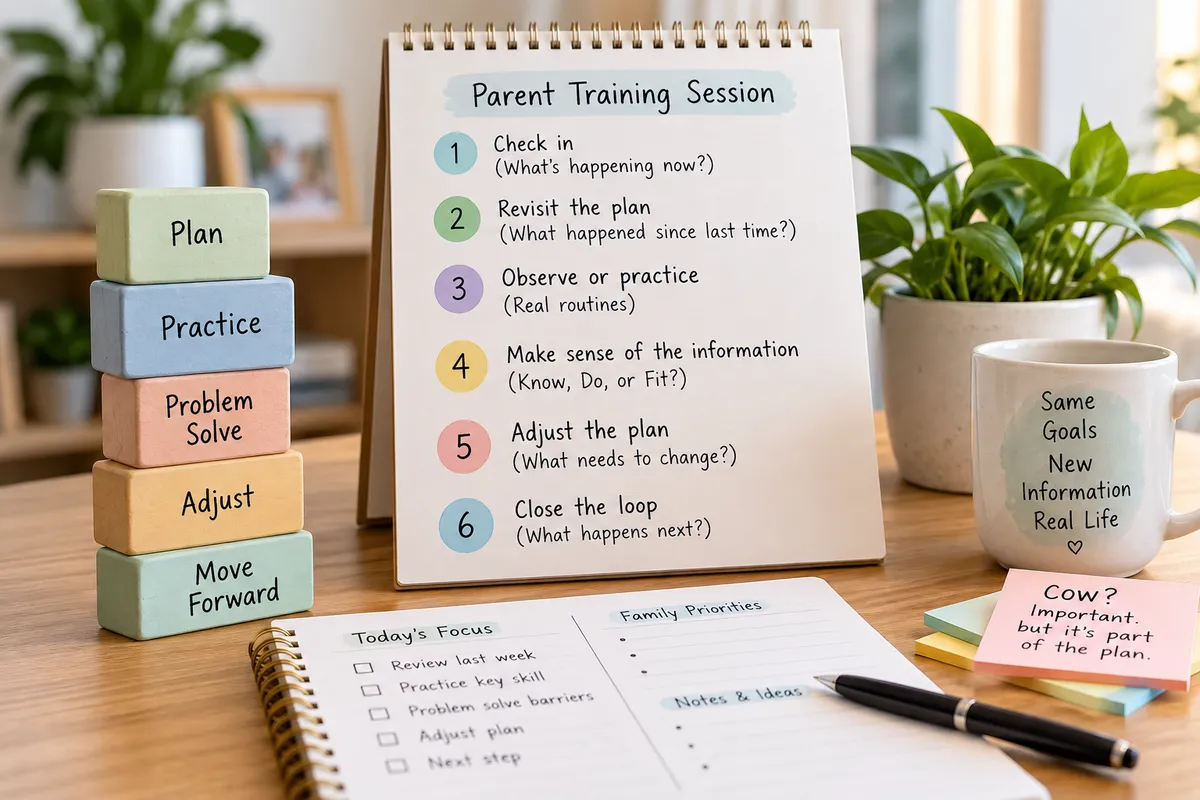
A simple structure for a one-hour session
The exact timing can change, but this is the general flow I use:
1. Check in with the family.
Find out what has happened since the last session and whether anything changes the priority for today.
2. Revisit the existing plan.
What did the caregiver try? What worked? What felt hard? What got in the way?
3. Observe or practice.
See what the skill looks like under the conditions where the family actually needs it. This might involve role-play, a live routine, or reviewing specific examples.
4. Decide what the information means.
Is the caregiver ready to build on the skill? Does the current target need more work? Is the issue Know, Do, or Fit?
5. Adjust the plan.
Change the strategy, routine, level of support, environment, or expectations if that is what the data suggest.
6. Close the loop.
Return to the concern the parent brought in, decide what happens before the next session, and identify what you want to learn next time.
The video transcript you provided shows this six-part structure in detail, including how the COW is revisited after the BCBA has gathered more context rather than being dismissed or allowed to consume the entire hour.
Structure should protect collaboration, not replace it
A session plan can become just as problematic as a completely reactive session if the BCBA becomes so committed to the agenda that there is no room for the family’s priorities.
That is not the goal.
The caregiver-coaching literature repeatedly points to collaboration as a core component of effective practice. Pellecchia and colleagues define collaboration as actively involving caregivers in selecting goals and intervention strategies. Albright and colleagues found that caregivers, providers, and agency leaders all identified caregiver-provider collaboration as a facilitator of coaching, particularly when communication was bidirectional and included feedback and problem solving. (Pellecchia et al., 2022; Albright et al., 2025).
Structure should help you remember the important clinical questions.
It should not prevent the answers from changing your plan.
Keep the caregiver goal visible
Reactive parent training is much easier to avoid when the caregiver goal is specific.
“Discuss behavior concerns” does not create much continuity.
Neither does:
Parent will understand reinforcement.
A measurable caregiver goal gives you something concrete to return to each week.
If the family is working on transitions, communication opportunities, prompting, or responding to assent withdrawal, you can ask what happened with that skill, observe it, measure it, and decide what comes next.
See How to Write Measurable ABA Parent Training Goalsfor examples of building caregiver goals collaboratively and measuring caregiver behavior rather than just attendance or exposure to training.
Keep the feedback loop short enough to be useful
The point of the next step is not to assign homework for the sake of having homework.
It is to create information for the next clinical decision.
The caregiver tries something.
You see what happens.
You adjust.
Frost and Ingersoll identified planning for practice and reflecting on practice as important parts of the caregiver-learning process. A concrete plan made practice feel more feasible, while reflection gave caregivers and clinicians a way to adapt intervention based on what actually happened. (Frost & Ingersoll, 2025).
That is why continuity matters.
If the next session starts from scratch, much of the information from the previous week is lost.
Better structure also improves documentation
When the sessions connect, the note becomes easier to write.
Instead of:
Reviewed current concerns with parent. Discussed strategies and answered questions.
you can document:
which caregiver goal was addressed;
what happened since the previous session;
what the caregiver practiced;
what the BCBA observed;
what barrier or strength was identified;
what changed in the plan; and
what will happen next.
That produces a record of caregiver progress instead of a series of summaries showing that conversations occurred.
See What to Include in an ABA Parent Training Notefor examples of how to turn that information into a SOAP-based narrative note.
Use the Session Companion to keep the clinical thread visible
The free ACHIEVE Session Companionwas created to help with this exact process.
Before the session, you can identify the current caregiver goal and what you want to follow up on.
During the session, you can capture what the caregiver reports, what you observe or practice, barriers that come up, and changes you make to the plan.
At the end, you can identify the next step and use the same information to help write the parent training note.
[Add Session Companion CTA here]
Parent training does not need to become less responsive in order to become more structured.
The latest concern may be exactly the information you need.
The difference is whether that concern starts a completely new conversation every week or becomes part of an ongoing coaching process that helps you understand what the family needs next.
References
Allen, K. D., & Warzak, W. J. (2000). The problem of parental nonadherence in clinical behavior analysis: Effective treatment is not enough. Journal of Applied Behavior Analysis, 33(3), 373–391. https://doi.org/10.1901/jaba.2000.33-373.
Albright, J., Shinall, J. A., Tomczuk, L., et al. (2025). A multi-constituent qualitative examination of facilitators and barriers to caregiver coaching for autistic children in publicly funded early intervention. Autism, 29(1), 130–142. https://doi.org/10.1177/13623613241272993.
Ferretti, L. A., Uhl, A., Zawacki, J., & McCallion, P. (2025). Understanding barriers and facilitators of parent/caregiver involvement in home-based applied behavioral analysis programming for their autistic child. Children, 12(7), 850. https://doi.org/10.3390/children12070850.
Frost, K. M., & Ingersoll, B. (2025). Theory of change of caregiver coaching for an early parent-mediated autism intervention. Journal of Autism and Developmental Disorders. https://doi.org/10.1007/s10803-025-06767-2.
Pacia, C., Gunning, C., McTiernan, A., & Holloway, J. (2023). Developing the Parent-Coaching Assessment, Individualization, and Response to Stressors (PAIRS) Tool for Behavior Analysts. Journal of Autism and Developmental Disorders, 53(9), 3319–3342. https://doi.org/10.1007/s10803-022-05637-5.
Pellecchia, M., Mandell, D. S., Beidas, R. S., Dunst, C. J., Tomczuk, L., Newman, J., Zeigler, L., & Stahmer, A. C. (2022). Parent coaching in early intervention for autism spectrum disorder: A brief report. Journal of Early Intervention, 45(2), 185–197. https://doi.org/10.1177/10538151221095860.
Stocco, C. S., & Thompson, R. H. (2015). Contingency analysis of caregiver behavior: Implications for parent training and future directions. Journal of Applied Behavior Analysis, 48(2), 417–435. https://doi.org/10.1002/jaba.206.


