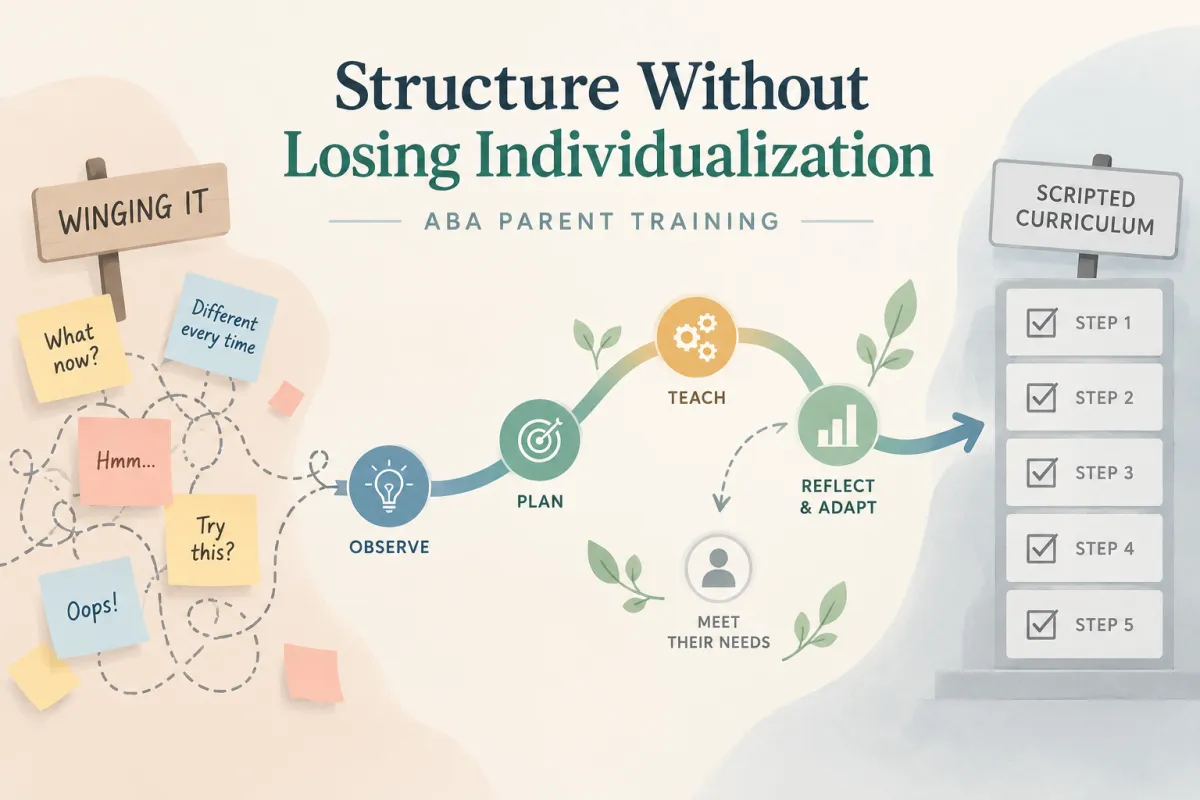
How to Structure ABA Parent Training Without Losing Individualization
One of the challenges with parent training is finding the balance between having enough structure to know where you’re going and enough flexibility to respond to the family in front of you.
Without structure, parent training can become reactive.
The parent comes in, you ask how the week went, they tell you what happened, you talk through the latest problem, and the session ends.
There may be useful conversation in there, but there isn’t always much connecting one meeting to the next.
On the other hand, too much structure creates a different problem.
If I’m committed to teaching the next lesson in a sequence simply because it’s next, I can easily miss the thing that matters most to the family right now.
That’s why I don’t think structure and individualization are opposites.
Good structure should help the BCBA make better clinical decisions.
It shouldn’t make those decisions for them.
Why completely unstructured parent training becomes difficult
It’s easy for parent training to turn into a weekly check-in.
That usually isn’t because the BCBA doesn’t care or doesn’t know what they’re doing.
BCBAs are managing a lot.
There’s treatment planning, supervision, staff training, data analysis, assessments, documentation, authorizations, collaboration, and everything else that comes with the job.
Parent training may be one of several meetings happening that day.
When there isn’t a clear structure, the easiest thing to do is start with whatever happened most recently.
Sometimes that works.
If there’s a pressing problem, it may be exactly where the session needs to go.
But if that becomes the entire system, it’s easy to lose direction.
The parent may bring a different concern every week.
The BCBA may make several good recommendations that never build on each other.
Something important from the previous session may never come up again.
Over time, parent training can start to feel like a series of disconnected conversations.
That’s where structure helps.
Structure gives the work continuity
A good parent-training structure gives the BCBA somewhere to start.
It helps keep track of what the family has already worked on, what happened when they tried it, and what makes sense to do next.
It can also reduce the amount of preparation the BCBA has to do before every meeting.
Instead of creating the session from scratch, there’s already a clinical framework to work from.
But structure is only useful if it can adapt.
The family’s needs should still determine the direction of the work.
The ACHIEVE Field Guide was designed around that balance. It describes the curriculum as a clinical framework with enough structure to support consistency and enough flexibility to fit the specific child, family, and context. It also explicitly tells BCBAs not to assume every section will apply to every family.
That distinction matters.
The curriculum is there to support clinical judgment.
It isn’t there to replace it.
The next lesson isn’t always the right next step
This was one of the biggest shifts in the way I started thinking about parent training.
The original ACHIEVE curriculum is concept based.
It gives BCBAs a structured sequence of behavioral concepts that are useful for parents to understand.
There’s still a lot of value in that approach.
Sometimes a parent really does need a stronger foundation in reinforcement, prompting, function, or generalization.
But over time, I realized that the family’s most important problem doesn’t always line up neatly with the next concept in a curriculum.
A parent may be struggling with bedtime.
Another family may be trying to get out of the house in the morning.
Someone else may be dealing with communication problems, difficult transitions, sibling conflict, or a child who’s becoming increasingly dependent on adult help.
Sometimes the most useful starting point is simply the thing that’s making life hardest.
The behavior analysis still guides what I do.
I’m just not requiring the family to enter through the behavioral terminology.
That became the foundation of the newer Problem-Solving ACHIEVE curriculum. It’s organized around the kinds of problems families actually describe, while the BCBA guide underneath it provides the clinical foundations, research, session guidance, fidelity criteria, and documentation support.
Individualization doesn’t mean starting from scratch
I think this is where BCBAs can sometimes get stuck.
We want parent training to be individualized, so we feel like we need to build something completely unique for every family.
But individualized care doesn’t have to mean reinventing the process every week.
The same behavioral principles show up across many families.
The same kinds of problems repeat.
What changes is how those principles are applied.
Two families may both be struggling with following directions.
For one family, the biggest issue may be how instructions are being delivered.
For another, it may be that demands happen during a time of day when the child is exhausted.
For another, the child may not have the skills needed to complete what’s being asked.
For another, the parent may be giving an instruction and then doing the task for the child almost immediately.
The presenting problem can look similar.
The clinical variables underneath it can be very different.
That’s where the BCBA matters.
The structure helps organize the possibilities.
The BCBA decides what applies.
A curriculum should narrow the field, not close it
This is probably the simplest way I think about it now.
A good curriculum narrows the field.
It gives me relevant concepts, strategies, things to assess, ways to explain them, and possible next steps.
But it doesn’t close the field.
I still need to observe.
I still need to listen to the parent.
I still need to understand the child’s behavior.
I still need to notice when the strategy doesn’t fit.
I still need to change direction when something more important comes up.
Sometimes I need to slow down.
Sometimes I need to skip something entirely.
Sometimes a family needs more practice before they need more information.
Sometimes the clinical issue isn’t the one I originally thought it was.
The newer ACHIEVE guide is built to allow that kind of movement. BCBAs are instructed to use clinical judgment to select the sections that are relevant, check whether prerequisite skills or conditions are in place, and move forward based on fidelity and mastery rather than a fixed schedule.
That’s much closer to the way I actually want to practice.
Structure also makes it easier to follow up
One of the biggest problems with reactive parent training is that recommendations can disappear from one week to the next.
A strategy comes up in conversation.
The parent agrees to try it.
Then the next week brings a completely different problem and nobody circles back.
A little structure makes follow-up much easier.
We can look at what the parent tried.
We can see what worked.
We can see where things fell apart.
Then the next session grows out of what happened before.
That’s when parent training starts feeling like an actual process instead of a series of isolated conversations.
The parent doesn’t have to come up with the entire agenda.
The BCBA doesn’t have to invent one either.
There’s already something to build from.
The live session should still belong to the family
I don’t want structure to turn parent training into a lecture.
That’s particularly important when there’s limited time.
If I spend most of the session delivering information, there’s less time for the parts of parent training that require me to be there.
Listening.
Watching.
Coaching.
Practicing.
Troubleshooting.
Adjusting a strategy.
Figuring out why something worked in one situation and not another.
That’s one of the reasons I like having parent-facing material available outside the live session.
In the newer ACHIEVE curriculum, every section has a parent-facing video. The parent can receive some of the didactic teaching without the BCBA needing to deliver every explanation from scratch.
Then the live session can focus much more heavily on application.
The structure is already there.
The BCBA can spend more time individualizing it.
Knowing when to leave the plan matters too
Having a plan doesn’t mean you have to follow it no matter what happens.
Sometimes a parent comes into a session with something genuinely urgent.
Sometimes new information changes the way you understand the problem.
Sometimes what you planned simply isn’t what the family needs that day.
That’s okay.
The difference is that you’re intentionally choosing to leave the plan rather than having no plan at all.
And when the immediate issue is addressed, you still know where the larger work was headed.
That makes flexibility much easier.
Structure should reduce cognitive load for the BCBA
There’s another benefit to having a good framework that I don’t think gets talked about enough.
It reduces the amount of thinking that has to happen before you can even begin the clinical work.
If I have to search through old notes, dig through PDFs, build a handout, decide what to teach, and figure out how to explain it every single time I meet with a parent, I’ve used a lot of cognitive energy before the session even starts.
A good system should take some of that load away.
Not the clinical decision-making.
The repetitive parts.
The structure.
The explanations.
The parent-facing materials.
The possible next steps.
That leaves more capacity for the parts of the work that actually require a BCBA.
Good structure makes flexibility easier
I don’t think the choice is between a rigid curriculum and completely individualized parent training.
There’s a useful middle ground.
You can have a framework.
You can have a plan.
You can know where the family has been and where you might go next.
And you can still change direction.
You can still follow the family’s priorities.
You can still adapt the recommendation.
You can still use your clinical judgment.
That’s the kind of structure I want in parent training.
Enough that I’m not reinventing everything every week.
Enough that the work has continuity.
But never so much that the family has to fit the curriculum.
The curriculum should fit the family.
That balance between structure and flexibility is a big part of how we built ACHIEVE. If you want to see the Classic and Problem-Solving approaches and decide which fits the way you work with families, you can explore ACHIEVE here.
Structure doesn’t have to mean using the same session plan with every family. The free ACHIEVE Session Companion gives you a framework for planning the session while leaving room for what that family needs that day. Free Download: ACHIEVE Session Companion.


