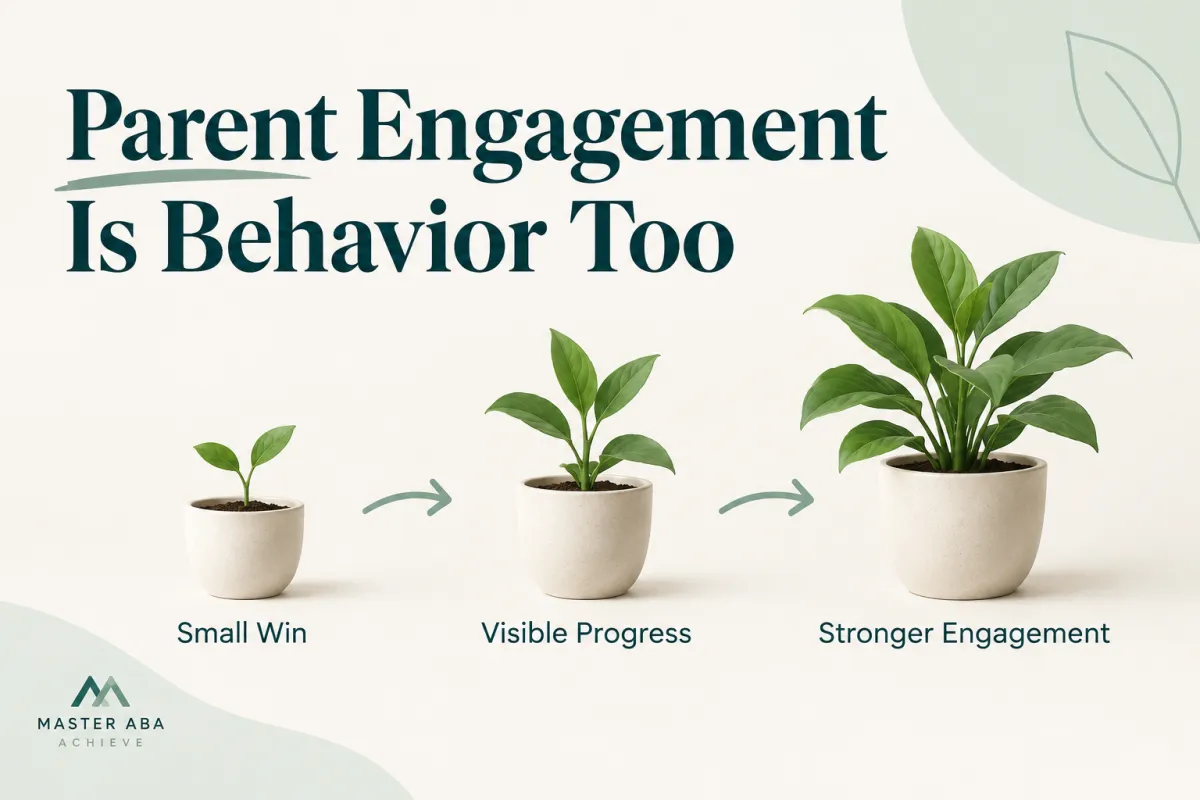
Parent Engagement Is Behavior Too: Using Quick Wins in Parent Training
BCBAs spend a lot of time thinking about reinforcement.
We look at what increases behavior. We consider response effort, motivating variables, competing reinforcers, and the context in which behavior occurs.
Then when it comes to parent training, there can sometimes be an expectation that parents will participate because we tell them the training is important.
That has never made much sense to me.
Parent participation is behavior too.
If we want parents to keep showing up, trying strategies, and engaging in the process, it helps when they actually experience something valuable from it.
That is why I like to start with quick wins.
What I mean by a quick win
A quick win is not a trivial goal chosen just so we can say something worked.
It is a meaningful change that is small enough to be achievable early in the process.
Maybe one part of the morning routine gets easier.
Maybe a transition goes more smoothly.
Maybe the parent sees their child communicate a need in a new way.
Maybe bedtime is ten minutes shorter.
Maybe the parent understands a pattern in their child’s behavior that suddenly makes the situation feel more manageable.
The point is not that every problem should be solved quickly.
The point is that the parent gets to experience the value of the process early.
When they try something and it helps, even a little, parent training becomes more than another appointment they are expected to attend.
It becomes useful.
Why this matters for parent participation
We often talk about caregiver “buy-in” as though it is something the parent either has or does not have.
I think that framing can be too simple.
A parent may care deeply about helping their child and still not see much value in a training session.
The session may feel repetitive.
The recommendations may not fit their routine.
The strategy may require more effort than they realistically have available.
The topic may not address the thing that is making life difficult right now.
Or the parent may have attended several sessions without seeing anything change.
If that is the history associated with parent training, it should not surprise us when participation becomes inconsistent.
We would not ignore that kind of learning history with a client.
We should not ignore it with caregivers either.
Start with something the family actually cares about
One of the easiest ways to miss a quick win is to start with the concept we want to teach instead of the problem the family wants help solving.
A BCBA may be thinking about reinforcement, prompting, function, or antecedent interventions.
The parent may be thinking about getting out the door in the morning without a 30-minute battle.
Both perspectives matter.
The behavior analysis helps us understand what is happening.
But the family’s priorities help determine where the work should start.
That is one of the reasons I like problem-based parent training.
When the starting point is something the parent already wants to change, the intervention has a better chance of producing an outcome the parent actually values.
Small does not mean insignificant
Sometimes we overlook small improvements because we are focused on larger treatment goals.
But from a caregiver’s perspective, small changes can matter a lot.
If a parent has been spending 45 minutes getting a child into the car and that drops to 30 minutes, that may be a meaningful improvement in daily life.
If a child begins asking for a break before escalating once or twice a day, that may change the entire tone of the interaction.
If a parent learns one way to make instructions clearer and notices less conflict, they now have a reason to keep using that strategy.
Those outcomes may seem small compared with the long-term clinical goals.
But they create momentum.
And momentum matters.
A quick win should still be clinically meaningful
There is an important distinction here.
We are not choosing easy goals just to make parents happy.
The change still needs to make clinical sense.
The goal is to identify something that matters to the family and is realistic enough to produce early progress.
Sometimes that means narrowing the target.
Sometimes it means changing only one part of a routine.
Sometimes it means reducing the response effort of the strategy.
Sometimes it means teaching a simpler replacement behavior first.
Sometimes it means adjusting our own recommendation because what looked good in a treatment plan is not realistic in this family’s life.
The BCBA still brings the clinical judgment.
The quick win just helps us apply that judgment in a way that lets the family experience success.
Response effort matters for parents too
A strategy can be technically sound and still be too difficult to use consistently.
This is something I think BCBAs sometimes overlook.
We may design a plan with several steps, give a clear rationale, and then wonder why the parent is not implementing it.
But implementation may happen during the most difficult part of the day.
There may be multiple caregivers with different schedules.
The parent may be trying to manage siblings, dinner, homework, work demands, or their own exhaustion.
The strategy may simply require too much effort in that context.
That does not mean the parent does not care.
It may mean the plan needs to change.
Sometimes the best thing I can do in parent training is make the next step smaller.
Not less important.
Just more realistic.
Parent training should create value, not just deliver information
This is where I think parent training can become too focused on education.
Teaching concepts matters.
But information alone is not always reinforcing.
A parent can understand reinforcement and still have no idea what to do at bedtime.
They can understand function and still feel overwhelmed when their child becomes distressed in public.
They can understand prompting and still struggle to fade support during a rushed morning routine.
The live session is where the BCBA can connect the concept to the actual family.
That is where we listen, coach, practice, troubleshoot, and adjust.
The goal is not simply for the parent to understand the information.
The goal is for the information to help.
Why I meet with parents weekly
I have met with parents weekly for years, and I rarely have difficulty getting families to meet with me.
I do not think that is because my families are unusually motivated.
I think it is because I work hard to make those meetings useful from the beginning.
If the parent gives me an hour of their week, I want that hour to help with something they care about.
That may mean solving a small problem.
It may mean helping them understand their child differently.
It may mean adjusting a strategy that was not working.
It may mean practicing something together until it feels doable.
Once parents experience that value, they have a reason to keep coming back.
How this shaped ACHIEVE
This idea influenced the newer version of ACHIEVE.
The Problem-Solving curriculum is organized around the problems families actually bring to parent training rather than requiring every family to begin with the same sequence of ABA concepts.
The behavior analysis is still underneath the work.
The BCBA still decides what fits the family.
But the parent gets to enter through something that matters in their own life.
That creates more opportunities to find an early, meaningful success.
And in the online version, parent-facing lessons and videos can carry some of the didactic teaching outside of the limited live session.
That leaves the BCBA with more time for the part that requires clinical judgment: individualizing, coaching, troubleshooting, and helping the family use the strategy in real life.
Parent engagement is not something we can demand
I think this is the biggest point.
We cannot simply tell parents that parent training matters and expect that statement to sustain participation.
We can make the process valuable.
We can choose goals that matter.
We can reduce unnecessary response effort.
We can help parents contact meaningful outcomes.
We can listen when a plan does not fit.
And we can create enough early success that parent training becomes something the family sees as worth their time.
That is the kind of “buy-in” I am interested in.
Not compliance.
Value.
If you want to see how this approach is built into ACHIEVE, you can learn more about the Classic and Problem-Solving options here.
Once you identify a useful next step with a family, the free ACHIEVE Session Companion can help you carry it into the next session and track what happens. Free Download: ACHIEVE Session Companion.


