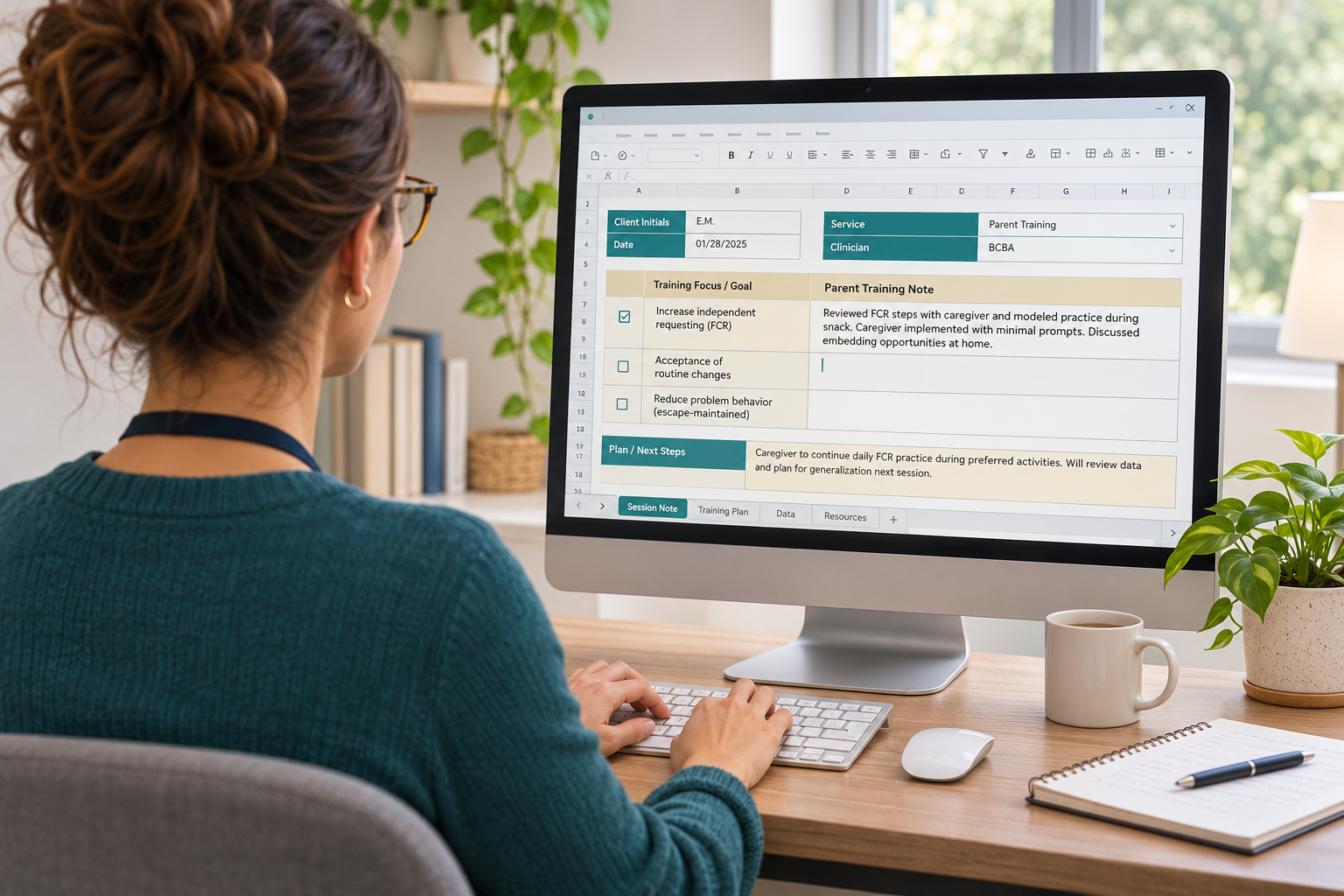
ABA Parent Training Note Example: Document Progress Without Starting From Scratch
Writing an ABA parent training note shouldn't require reconstructing an entire session from memory.
The challenge is often less about knowing what to document and more about having the relevant information available when it's time to write.
What caregiver goal were you addressing? What strategy did you coach? How did the caregiver perform? What did you observe that should influence the next session?
When goals, coaching records, and session notes live in separate places, answering those questions can take unnecessary time.
A more efficient approach is to organize information once, record what changes during each session, and use those details to write a concise clinical note.
What a Useful Parent Training Note Should Show
A parent training note should connect the service the BCBA provided with the caregiver's performance and the clinical decisions that followed.
Here's a fictional example showing those connections.
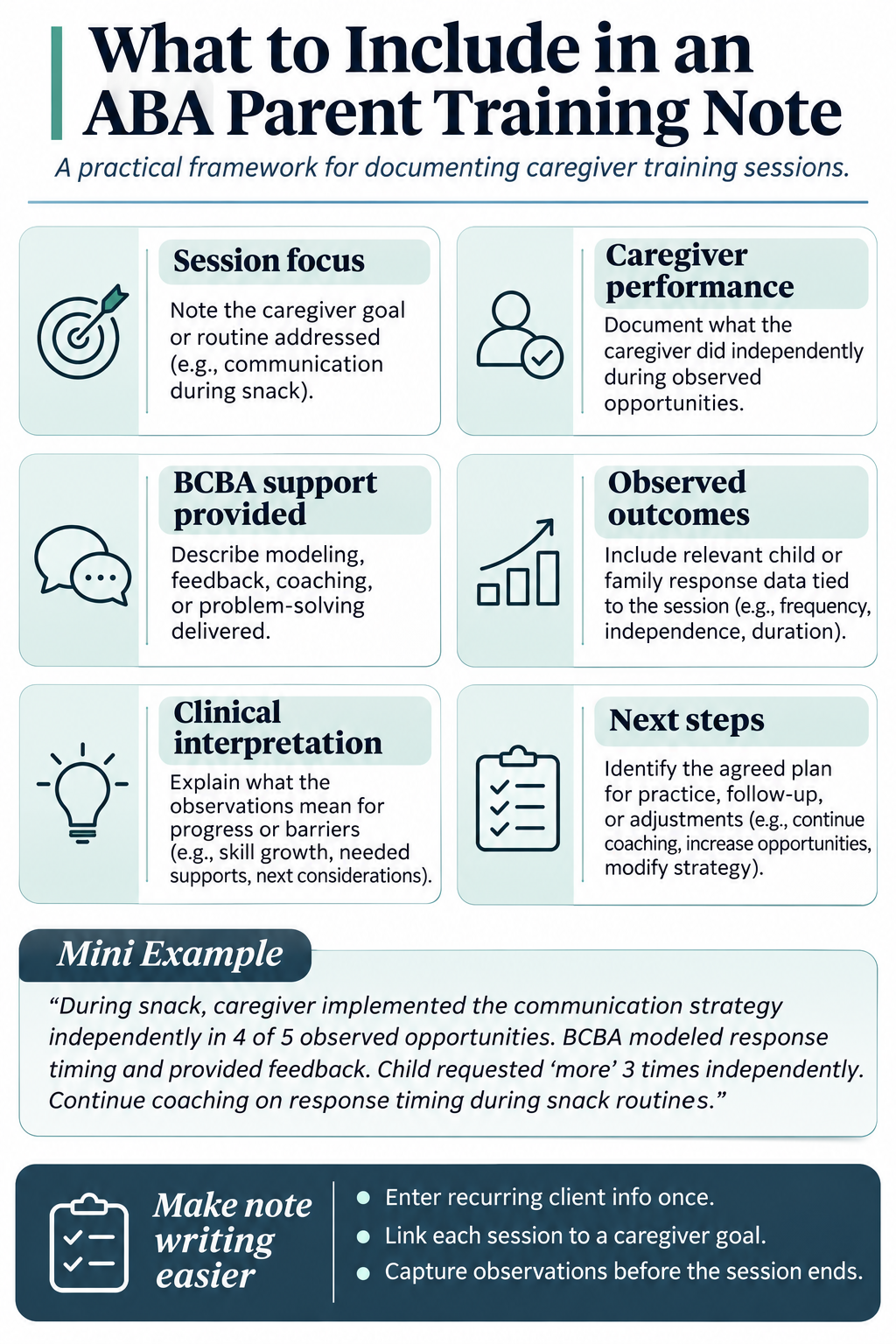
The key distinction is between what the BCBA coached, what the caregiver demonstrated, and what happened for the child or family.
That information becomes much easier to document when it's connected to an established caregiver-training goal rather than assembled after the session.
Start With Information You Shouldn't Have to Enter Twice
One way to reduce documentation time is to separate information that rarely changes from information specific to each session.
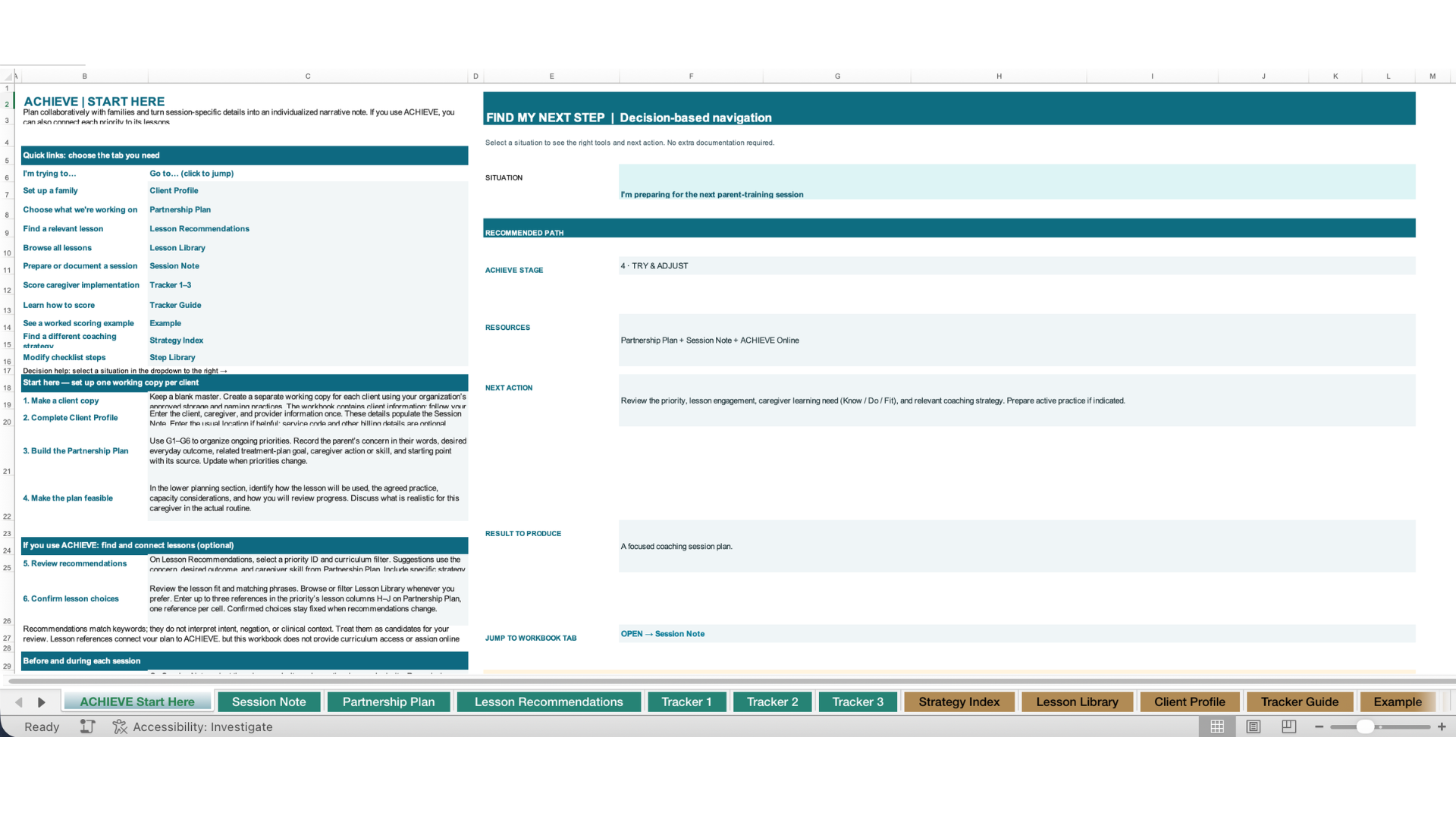
The free ACHIEVE Parent Training Toolkit uses this approach.
Its Start Here worksheet introduces the workflow and links to the other sections of the workbook.
The Client Profile is completed once for each family. It contains recurring information such as the client identifier, caregivers, provider credentials, usual location, and service code.
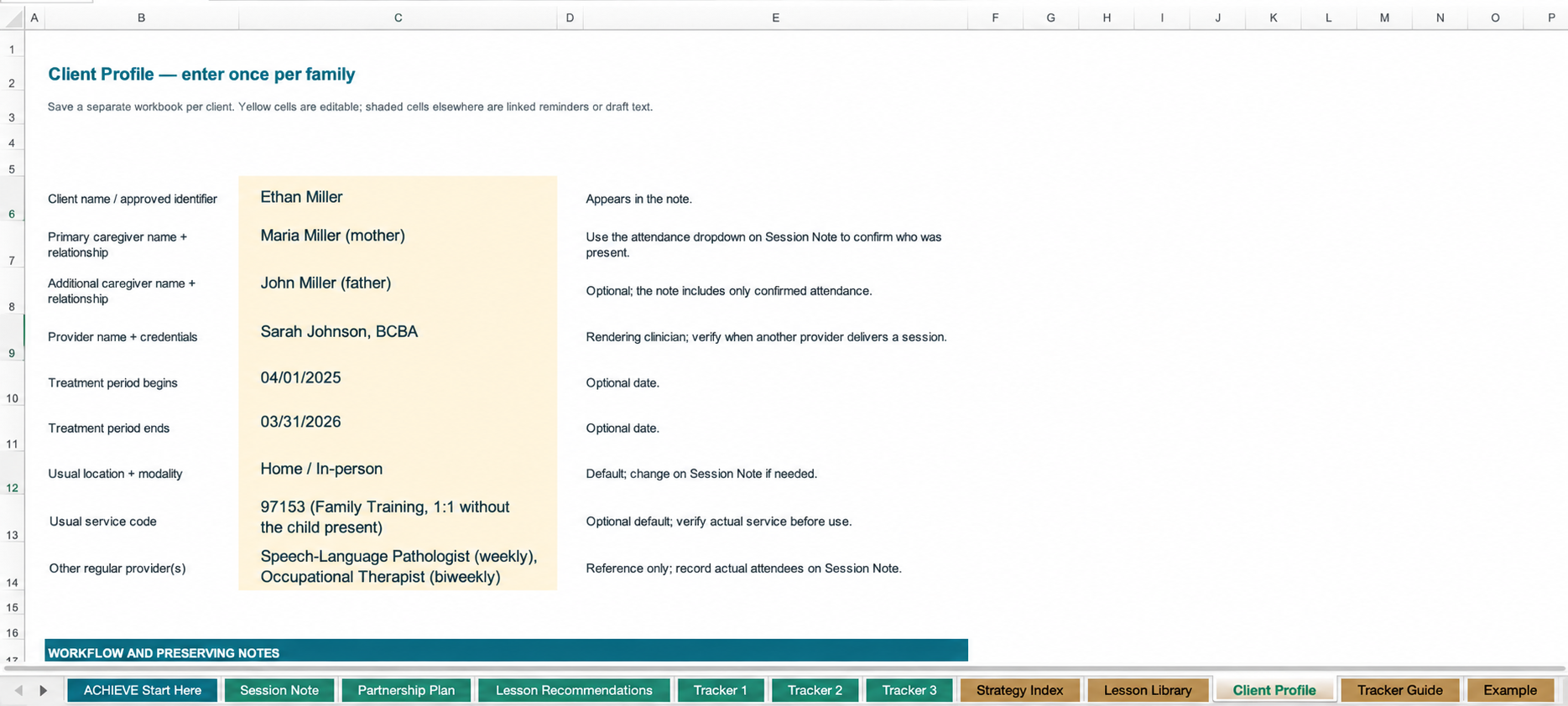
That information can then populate or serve as a reference in other parts of the workbook.
Of course, clinicians still need to confirm actual attendees, service details, and other session-specific information.
The benefit is simple: You shouldn't have to repeatedly type information that hasn't changed.
The same principle applies even if you use your organization's electronic health record instead of the toolkit. Templates and client profiles are most useful when they eliminate redundant entry without replacing verification of what actually occurred.
Connect the Note to the Caregiver Goal
A second source of unnecessary work is searching through the treatment plan to remember how the session relates to the caregiver's goals.
The toolkit's Parent Partnership Plan keeps that information together.
It includes the family's concern in their own words, the everyday outcome they're working toward, the related treatment-plan goal, the caregiver skill, and the selected approach with its rationale.
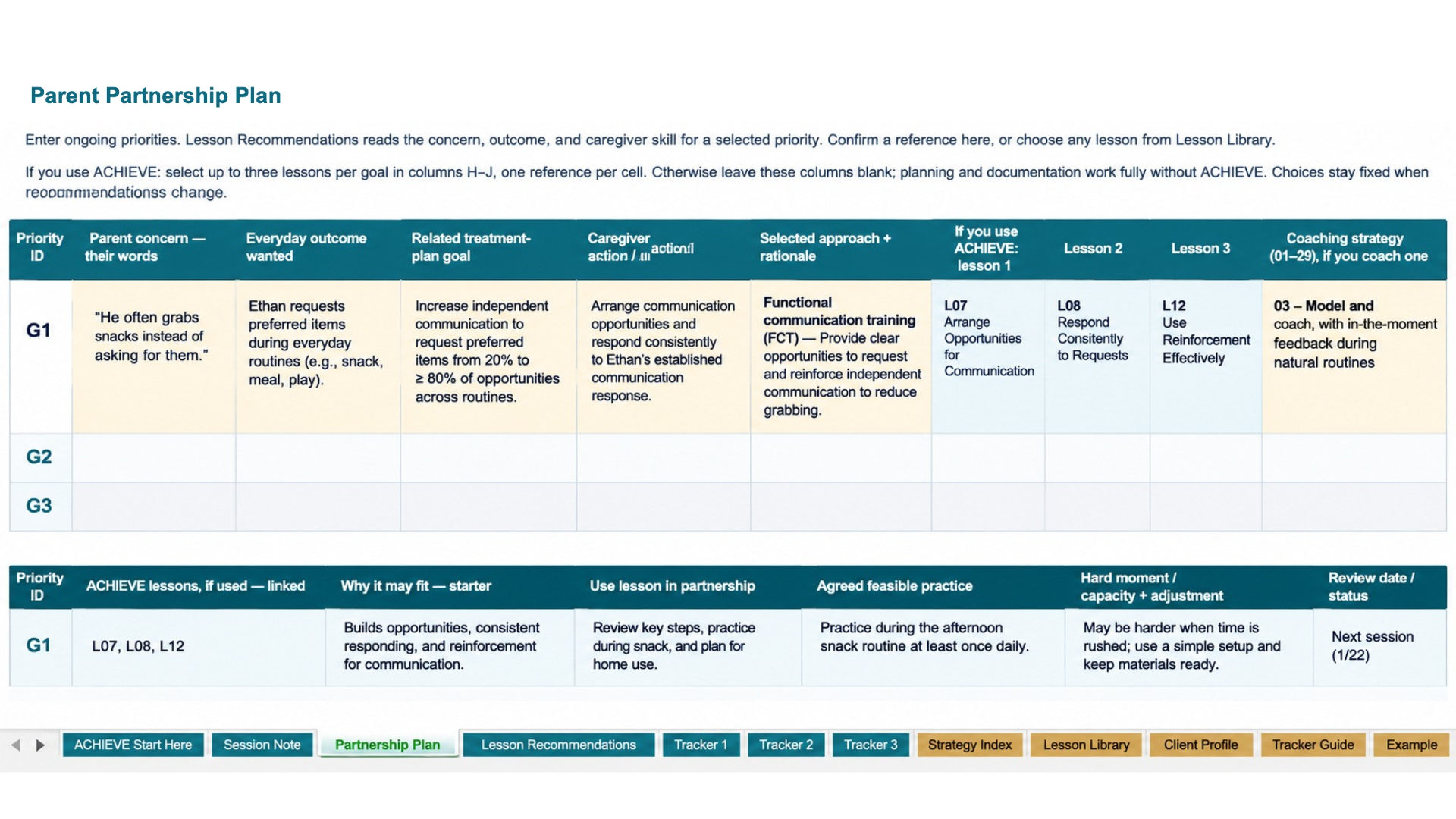
For example, suppose Maria wants Ethan to communicate when he wants more of a preferred snack rather than grabbing it.
The caregiver-training goal focuses on Maria arranging appropriate opportunities for Ethan to use his established communication response and responding according to the agreed plan.
That information provides the context for subsequent sessions.
The BCBA doesn't need to rewrite the entire clinical rationale every time. The session note can focus on what was addressed, what happened, and what the information means.
ABA Parent Training Note Example: From Session to Documentation
During an afternoon snack routine, the BCBA models the communication procedure and coaches Maria on arranging opportunities and allowing an appropriate response interval.
Maria independently implements the agreed procedure in four of five observed opportunities. She needs feedback on response timing during one opportunity.
Ethan independently requests “more” three times during the observation, and one episode of grabbing is recorded.
Here's how those observations could be incorporated into a concise clinical narrative:
Sample parent training note — fictional example
The BCBA provided caregiver guidance focused on implementing the established functional communication procedure during the afternoon snack routine. Services included modeling, observing caregiver implementation, and providing performance feedback on response timing.
Maria implemented the agreed procedure independently in 4 of 5 observed opportunities (80%), requiring feedback during one opportunity. Ethan independently requested “more” three times, and one episode of grabbing was observed.
Maria demonstrated independent implementation during most opportunities, with response timing remaining a focus for coaching. Continue practice during natural snack routines and evaluate caregiver independence with reduced immediate feedback. Collect comparable observations of Ethan's communication and grabbing to assess progress over time.
This note communicates what the clinician did, what the caregiver demonstrated, what was observed, and why continued coaching is appropriate.
It doesn't make unsupported claims about improvement from one observation.
Make the Note Easier to Write During the Session
The toolkit's Session Note worksheet organizes session-specific information into four areas:
Worksheet section | What to capture |
|---|---|
Caregiver Report | Relevant updates, priorities, and concerns |
BCBA Services and Observation | Clinical guidance, caregiver practice, and observed performance |
Clinical Interpretation | What the findings suggest about progress or barriers |
Agreed Next Steps | Continued coaching, adjustments, caregiver actions, and follow-up |
<textPlaceholder>[INSERT SCREENSHOT: SESSION NOTE WORKSHEET]</textPlaceholder>
The worksheet also incorporates reference information from other parts of the toolkit and includes a copy-ready narrative area.
That allows clinicians to organize relevant details throughout the session and review the draft before transferring it into their required documentation system.
The toolkit doesn't replace the clinic's billing or recordkeeping platform. It helps prepare the clinical information that goes into the note.
Three Ways to Spend Less Time Writing Parent Training Notes
1. Keep goals and clinical context in one place.
Use a client profile and caregiver-training plan that can be referenced across sessions. Avoid repeatedly reconstructing treatment goals, caregiver priorities, and intervention rationales.
2. Record observations while they're fresh.
Capture caregiver performance, feedback provided, and relevant child observations during or immediately after the activity. Use a consistent coaching record to identify what changed between sessions.
3. Let the clinical interpretation drive the next step.
Instead of ending every note with “Continue parent training,” identify the specific skill, condition, or outcome that needs further attention.
For example, if the caregiver demonstrates the strategy accurately during coaching but struggles when the BCBA isn't present, the next step might be to evaluate independent implementation in a more typical routine.
A concise note that explains that decision is more useful than a lengthy description of everything discussed.
Get the Free ACHIEVE Parent Training Toolkit
The ACHIEVE Parent Training Toolkit brings together the Client Profile, Parent Partnership Plan, Session Note, coaching trackers, and supporting resources in one workbook.
It's designed to help BCBAs organize caregiver-training information, connect sessions to meaningful goals, and prepare notes without repeatedly entering the same information.
GET THE FREE ACHIEVE PARENT TRAINING TOOLKIT
Whether you use this toolkit or another documentation system, the goal is the same: spend less time reconstructing sessions and more time using the information you've collected to guide caregiver training.
A clinically useful note should make it clear what was coached, what the caregiver demonstrated, and what needs to happen next. Always confirm that your final documentation meets your organization's and payer's requirements.


